
Contents
Foreword
Foreword from the Advisory Committee
It gives us great pleasure to present the 2025 Impact Report for Pela Terra II: Regenerate – Fundo de Capital de Risco Fechado (‘Pela Terra II’).
Impact is at the very heart of what we do. When we launched Pela Terra II in 2023, our vision was clear: we want to create a world in which agriculture contributes to restoring our planet, rather than being a factor in its destruction.
With many thousands of hectares of irrigated agricultural land, a climate ideally suited for Mediterranean perennials, diverse agricultural traditions and a supportive regulatory environment, Portugal offers the perfect location to roll out pioneering, forward-looking agronomic approaches.1
Pela Terra II leverages these advantages to offer a unique proposition: a golden visa-eligible investment that allows investors to invest in creating impact while earning European residency for themselves and their families.
We believe that the imperative to give back is not simply a moral one: multiple studies have suggested that funds that pay close attention to Environmental, Social and Governance (ESG) factors perform better than their non-ESG peers.23
In agriculture, this relationship is clear on the ground: the adoption of regenerative agronomy correlates strongly with more resilient and consistent returns.4 It’s easy to see why - while conventional agriculture is in itself a significant contributor to the destruction of natural systems, agriculture as an industry is almost uniquely exposed to the risks related to environmental collapse. Changing weather patterns and collapsing biodiversity hit farmers before they hit other industries.
Since we launched Pela Terra II in 2023, the environmental challenges facing our world have only become more acute. And as this report goes to press, ongoing geopolitical instability and resulting supply chain disruption are creating significant economic challenges for conventional farmers worldwide. The case for regenerative agriculture has never been stronger.
For agriculture more than for any other industry, ‘doing the right thing’ correlates with stronger, more resilient returns.
Social and environmental impact is hugely important to Pela Terra II. The goal is for the assets managed by the fund to serve as beacons of sustainable and regenerative good practice in Portugal and Europe more widely. However, we also want to go a step further: our approach is to act as a catalyst to drive impact at scale, leveraging both our own portfolio and strong relationships with partners and operators to drive change in the sector as a whole.
We are excited to share this impact journey with readers of this report.
— Alex Lawry-White and Nathan Hadlock
Executive Summary
Executive Summary
Humans need food to survive. But modern agriculture is harming both the planet and those it feeds. It contributes to climate change, fuels biodiversity collapse, and produces less nutritious food — while remaining among the industries most exposed to the very climate risks it helps create.
At Pela Terra, we see this as both a problem and an opportunity.
By applying regenerative approaches at scale on Portuguese farmland, we can begin to reverse the damage that decades of intensive agriculture have caused: rebuilding soil health, reducing chemical inputs, conserving water, protecting native species, and sequestering carbon - all while producing the healthy food we need and securing more resilient returns for our investors.
The solution is literally in the ground beneath our feet.
Across everything we do, we engage closely with farming, academic, and investment communities to share best practices, create jobs, and support change across the sector.
We work carefully to measure and track our progress, collaborating with selected measurement partners and reporting against external benchmarks and a fund-level set of KPIs that align with our six impact themes. We also disclose a wide range of other sustainability-related data to allow investors and interested parties to better understand our results.
This report sets out our progress over the past year, sharing what has been done and what we have learned along the way.
Six areas where we aim to make a difference
Pela Terra's impact strategy is built around six interconnected themes, aligned with the UN Sustainable Development Goals and tracked using a set of fund-level KPIs.
Between 60 and 70 per cent of EU soils are estimated to be unhealthy. We restore soil health through reduced tillage, cover cropping, and organic inputs, tracking progress across biological, chemical, and physical indicators.
Agriculture accounts for 72 per cent of global freshwater withdrawals. We apply precision irrigation, improve soil water retention, and restore native vegetation along waterways to reduce runoff and protect quality.
Soil is a natural carbon sink. By improving soil health we promote carbon sequestration, helping to combat climate change; in parallel, we work to reduce greenhouse gas emissions from our operations.
Healthy soils are a prerequisite for all biodiversity. In addition to promoting soil biodiversity, we set aside and manage significant areas of each property to protect and nurture a diverse range of plants, insects, birds and animals.
Healthier soils produce more nutritious food. By producing Portuguese staples – olive oil and nuts – at scale using regenerative practices, we are leading the transformation to food systems which work better for both people and planet.
The fund invests 100 per cent of its capital in Portugal, targeting rural areas. We work carefully across our supply chains to ensure fair conditions for all we interact with. We engage with partners and the wider investment and agriculture communities to push for changes where they are needed.
Please note that as Pela Terra II: Regenerate is not subject to Article 8 or to Article 9 of Regulation (EU) 2019/2088 of November 27th, 2019, the fund’s investments do not take into account the EU criteria for environmentally sustainable economic activities.
2025 Headlines
Our KPIs at a Glance
Our KPIs at a Glance
By 2030, we will:
UN SDGs and GIIN IRIS+ Impact Categories Targeted
UN SDGs and GIIN IRIS+ Impact Categories Targeted
UN Sustainable Development Goals targeted
Target 2.1 By 2030, end hunger and ensure access by all people, in particular the poor and people in vulnerable situations, including infants, to safe, nutritious and sufficient food all year round.
Target 2.4 By 2030, ensure sustainable food production systems and implement resilient agricultural practices that increase productivity and production, that help maintain ecosystems, that strengthen capacity for adaptation to climate change, extreme weather, drought, flooding and other disasters and that progressively improve land and soil quality.
Target 3.9 By 2030, substantially reduce the number of deaths and illnesses from hazardous chemicals and air, water and soil pollution and contamination.
Target 6.4 By 2030, substantially increase water-use efficiency across all sectors and ensure sustainable withdrawals and supply of freshwater to address water scarcity and substantially reduce the number of people suffering from water scarcity.
Target 7.2 By 2030, increase substantially the share of renewable energy in the global energy mix.
Target 8.8 Protect labour rights and promote safe and secure working environments for all workers, including migrant workers, in particular women migrants, and those in precarious employment.
Target 12.3 By 2030, halve per capita global food waste at the retail and consumer levels and reduce food losses along production and supply chains, including post-harvest losses.
Target 12.6 Encourage companies, especially large and transnational companies, to adopt sustainable practices and to integrate sustainability information into their reporting cycle.
Target 13.2 Integrate climate change measures into national policies, strategies and planning.
Target 15.3 By 2030, combat desertification, restore degraded land and soil, including land affected by desertification, drought and floods, and strive to achieve a land degradation-neutral world.
Target 15.5 Take urgent and significant action to reduce the degradation of natural habitats, halt the loss of biodiversity and, by 2020, protect and prevent the extinction of threatened species.
Target 15.a Mobilise and significantly increase financial resources from all sources to conserve and sustainably use biodiversity and ecosystems.
GIIN IRIS+ Categories and themes targeted
Food Security
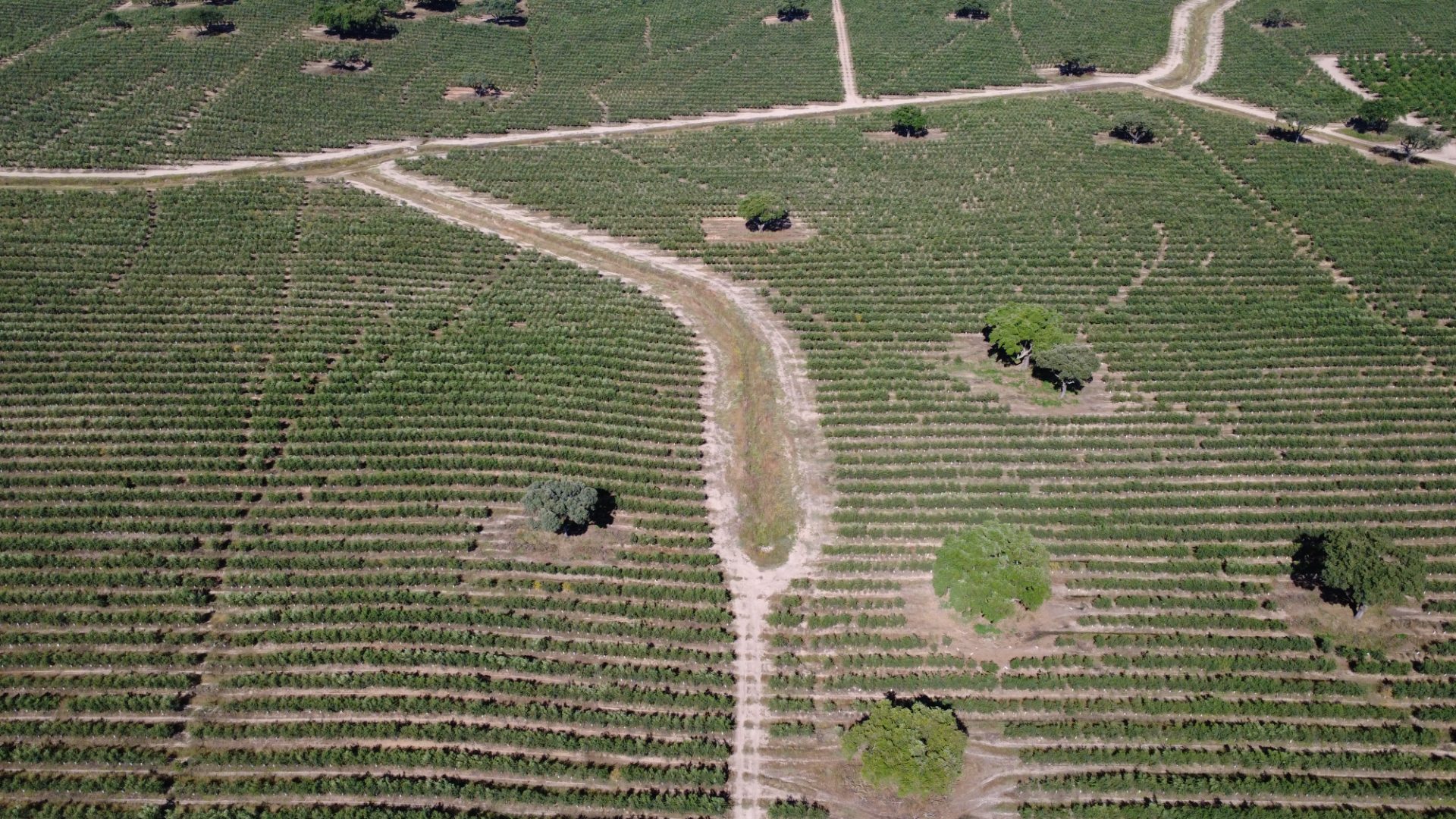
Our Portfolio
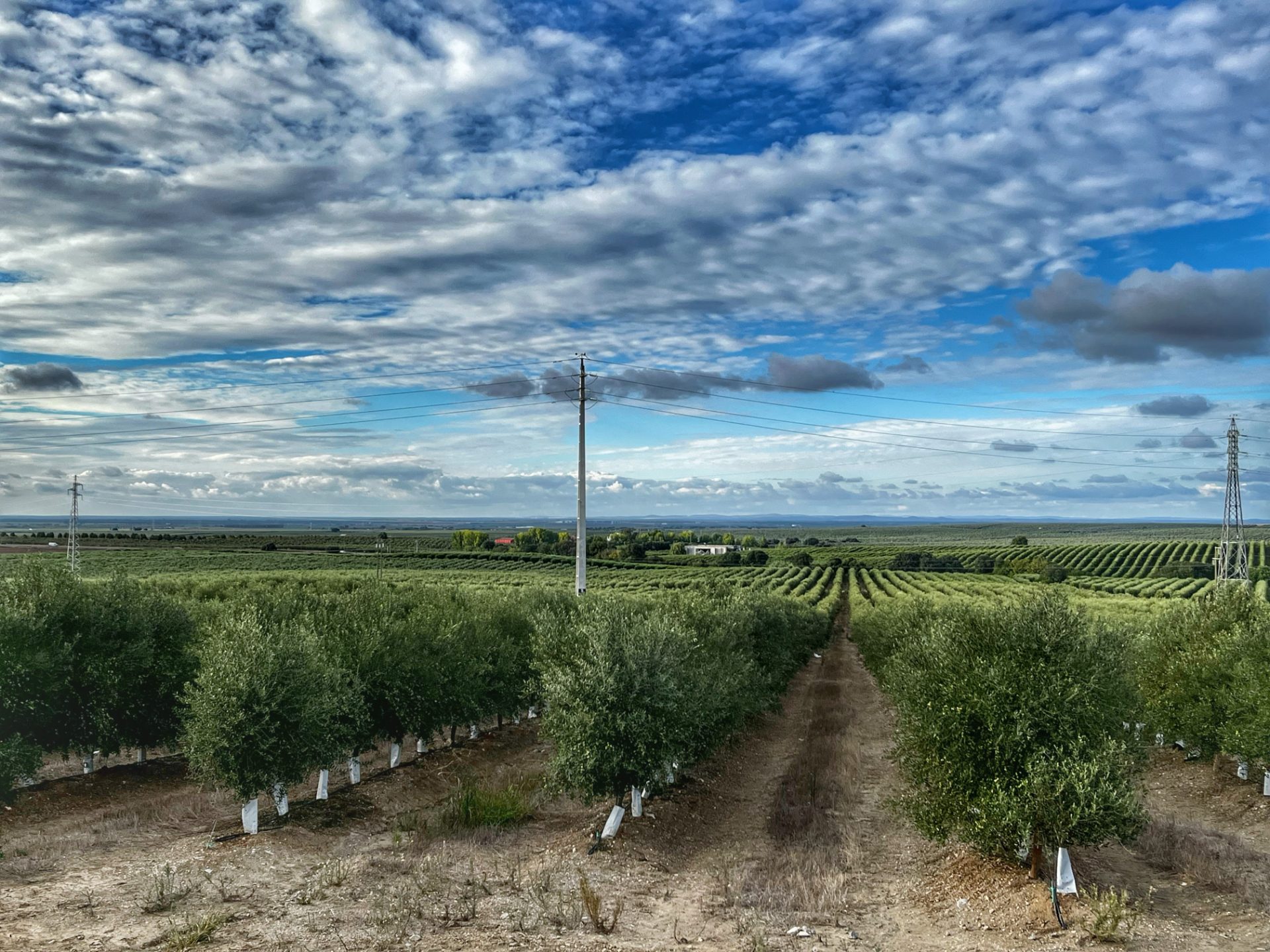
Located in the Alentejo agricultural region, in the district of Ferreira do Alentejo.
Herdade de Pombal and Palmeira are two separate properties located in the same area that are managed together. They have a total area of 285 hectares.
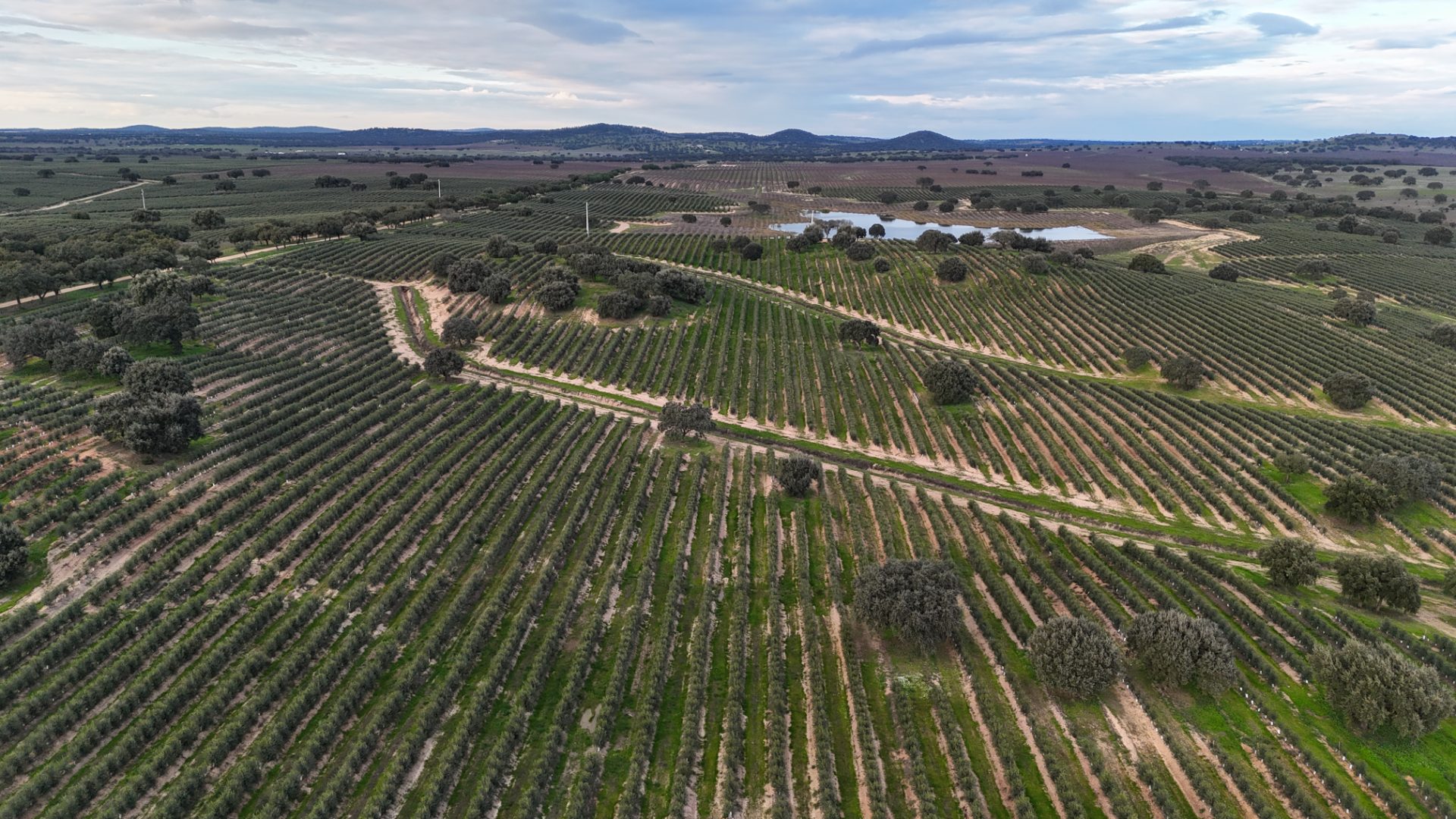
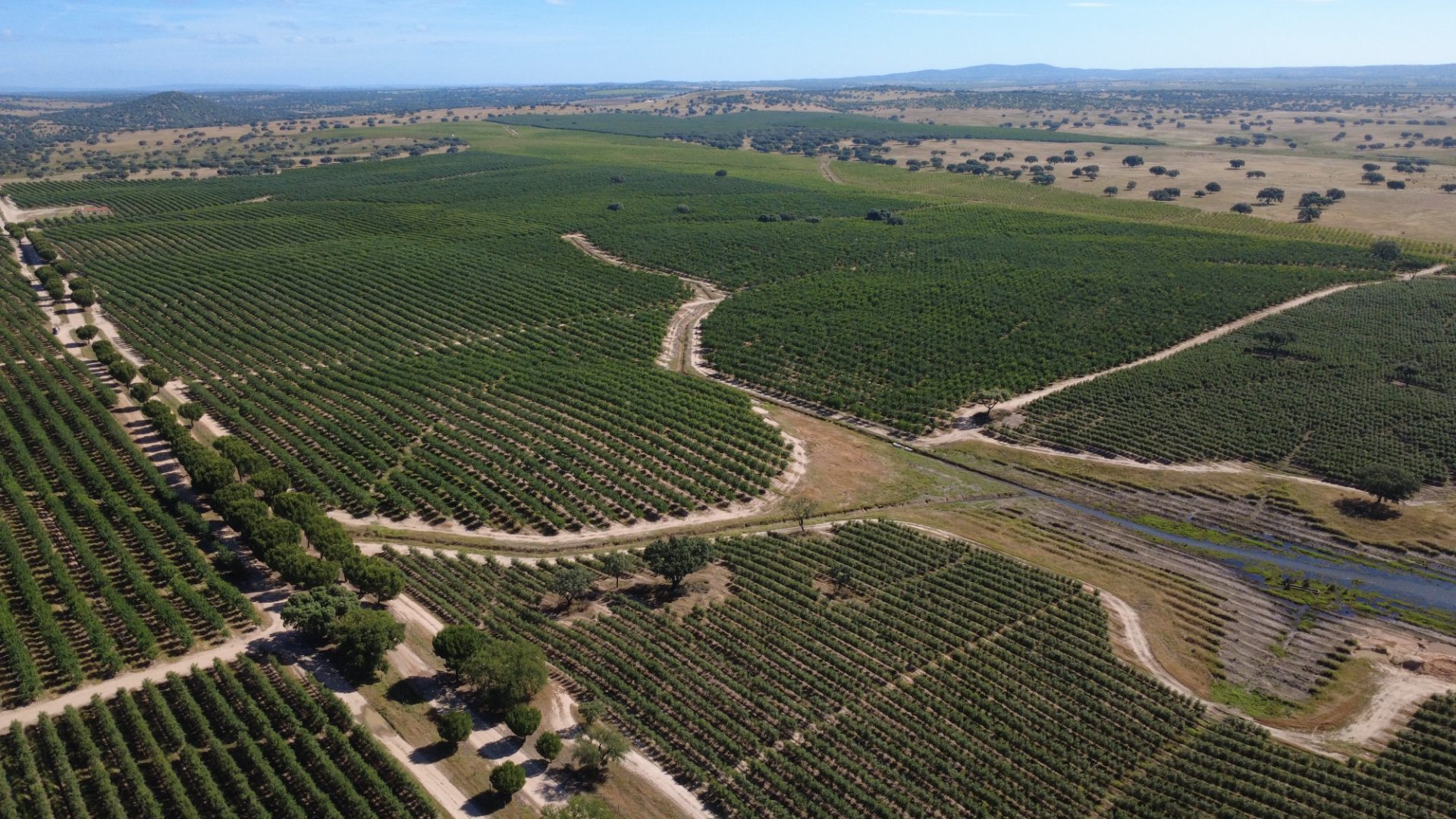
The main commercial crop grown is olives. Herdade de Pombal consists of 214 hectares, which are being replanted, starting late 2025, from high-density to super-high-density olive orchards.
Palmeira has 70 hectares of super-high-density olive orchards, planted in 2022.
In its current layout, almost 100% of the land is orchards, with very small areas classified as wet grassland and montado.
A detailed baseline assessment carried out by NBI has identified:
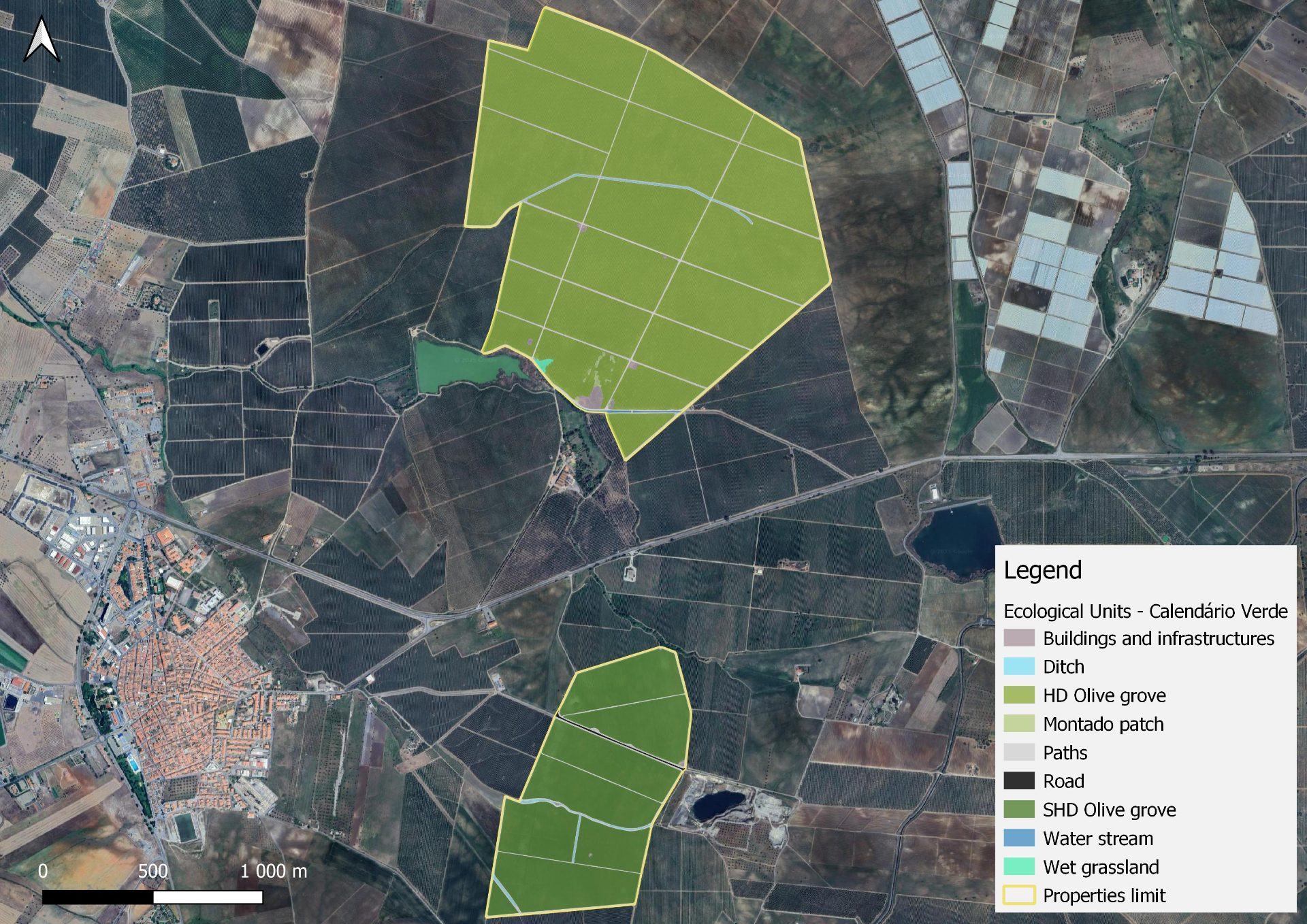
Located in the Alentejo agricultural region, in the municipality of Serpa.
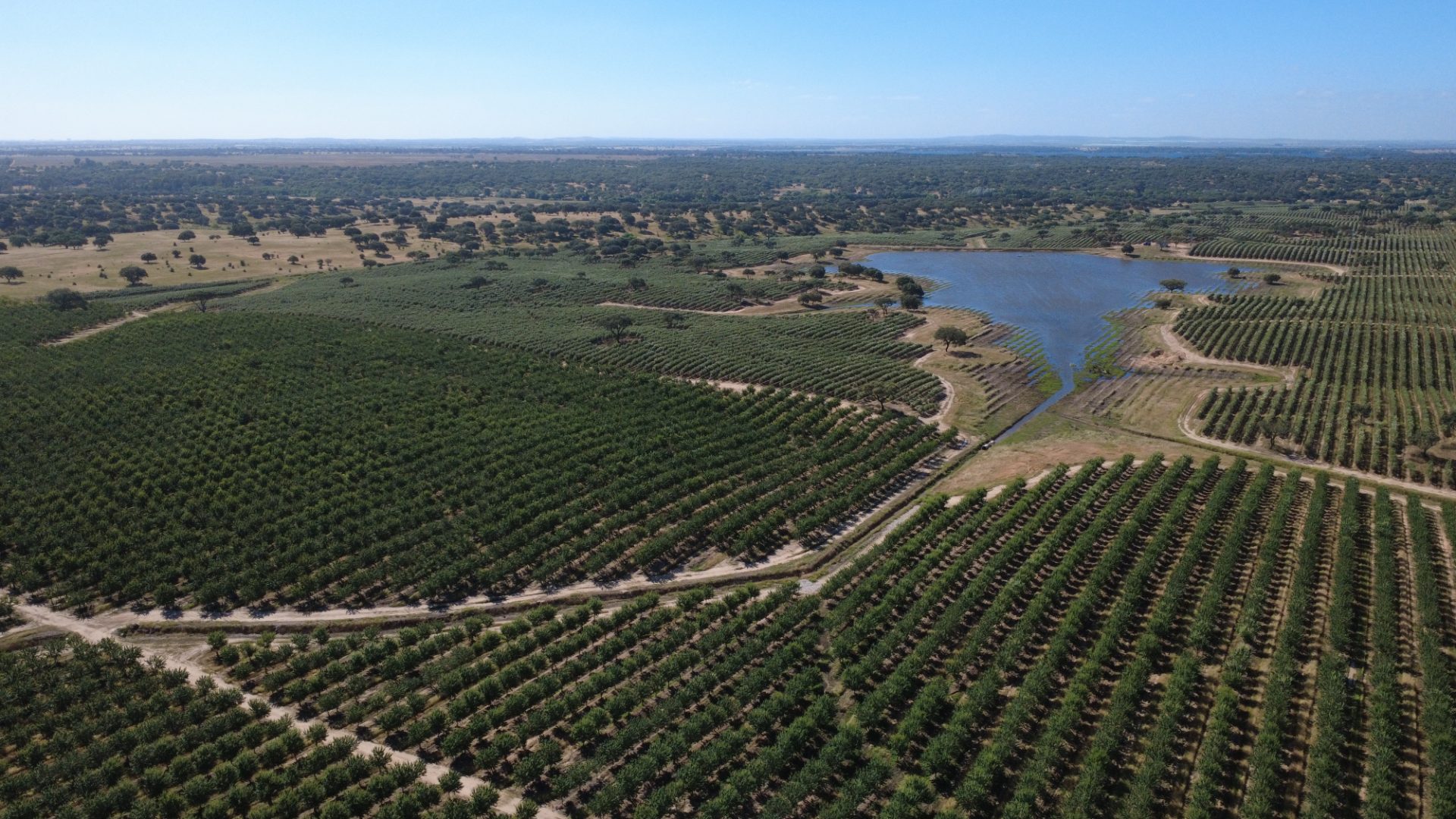
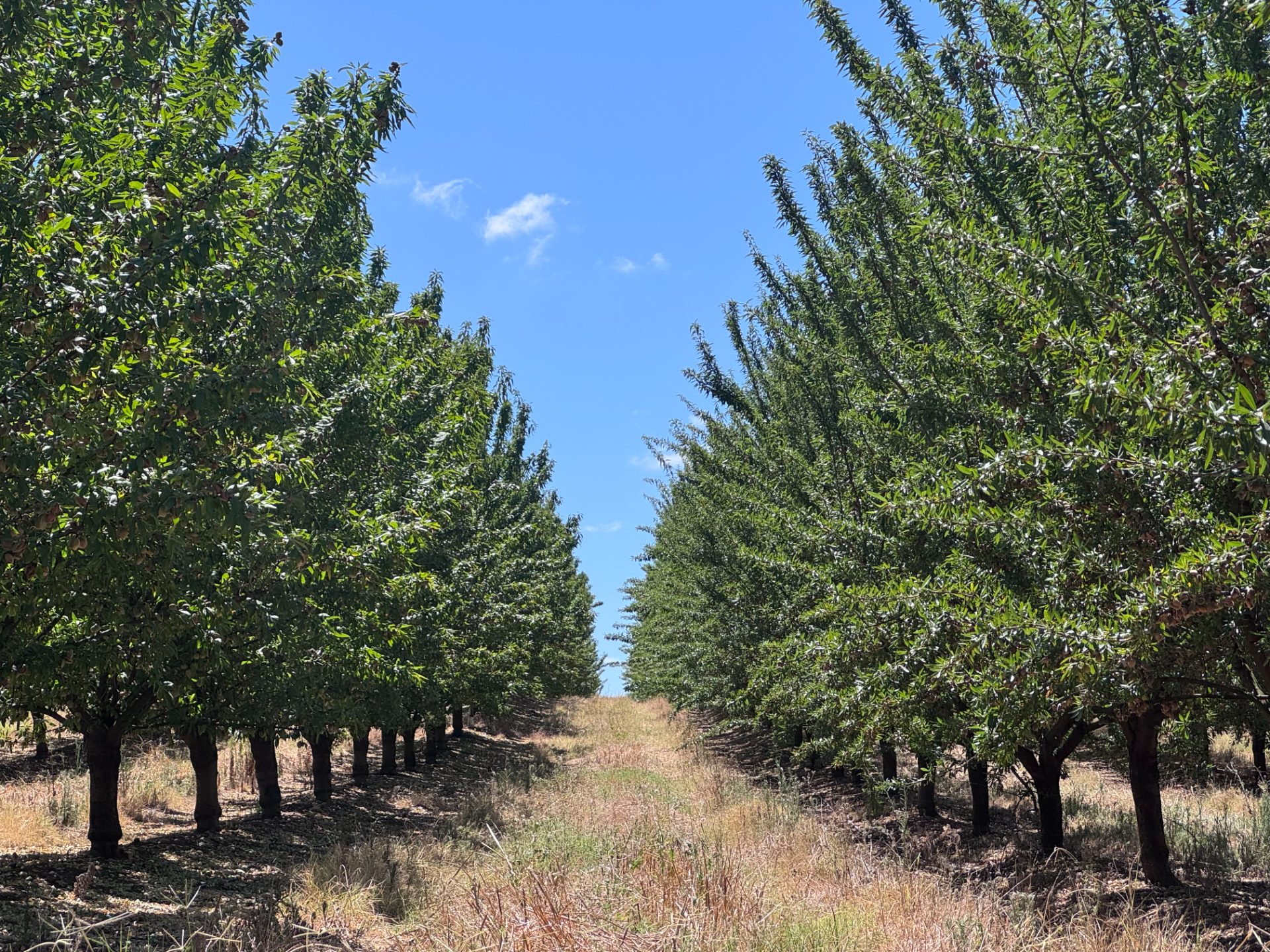
Herdade de Meirinho is a 70 ha, mature high-density almond orchard. The trees were planted in 2019, with two varieties, Marinada and Lauranne, each making up roughly 50% of the total orchard area.
In its current layout, almost 100% of the land is orchards, with very small areas classified as wet grassland and montado.
A detailed baseline assessment carried out by NBI has identified:
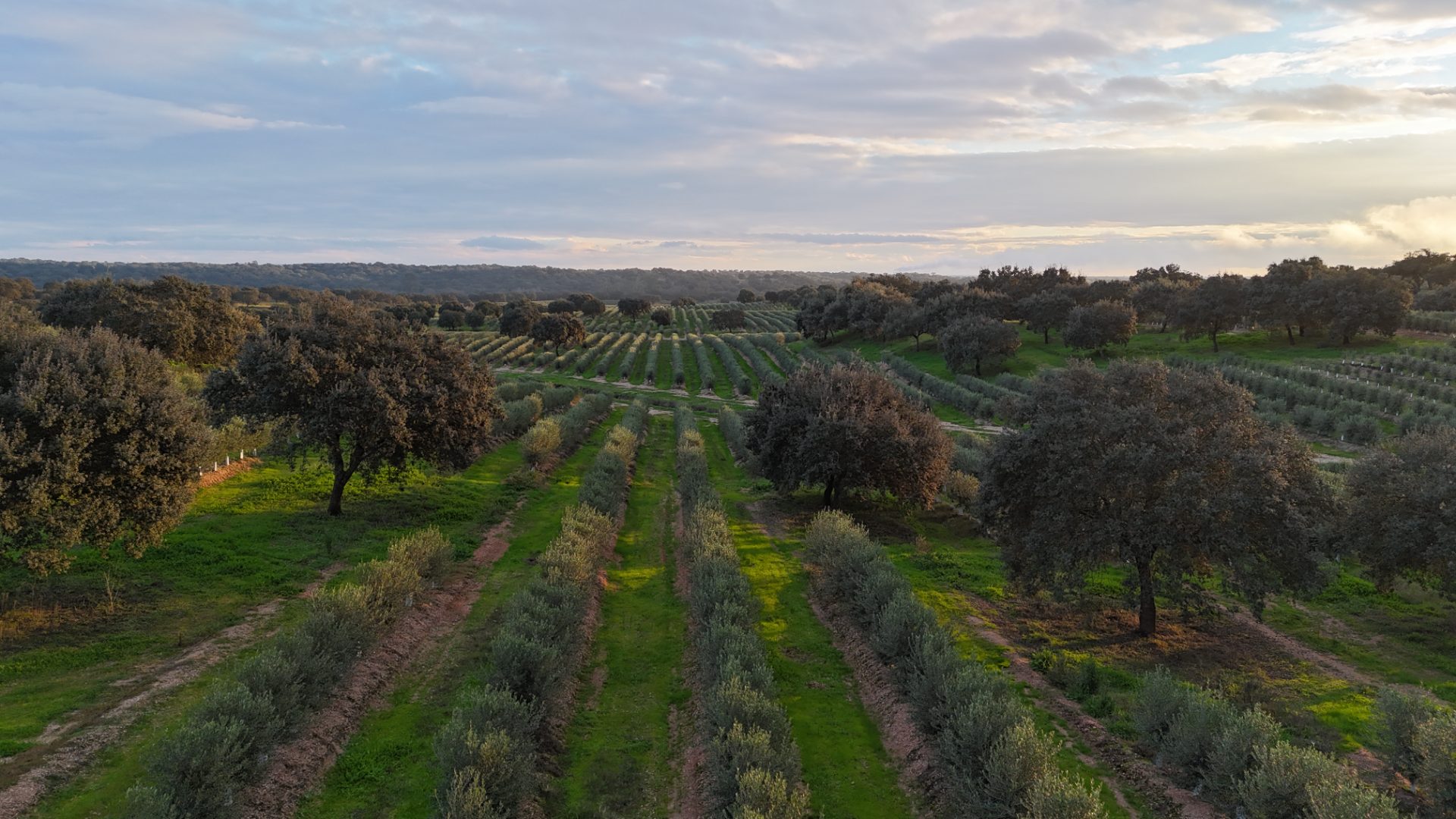
Located in the Ourique municipality of Alentejo, Herdade de Montinho & Monte Migueis are two adjacent properties of approximately 456 hectares in total, of which 370 are being developed for plantation as a super-intensive olive orchard. Pela Terra II concluded long-term rental agreements for the properties in late 2025.
A detailed baseline assessment carried out by NBI has identified:
How We Create Impact
The problem: conventional agriculture harms both the planet and those it feeds
Humans need food. However, the ways we currently grow it make agriculture one of the most significant contributors to the interlinked crises currently facing our planet: a changing climate, biodiversity collapse, degrading soils, and freshwater shortages.
Agriculture accounts for 72 per cent of all freshwater withdrawals globally5. The global agrifood system creates over a third of anthropogenic greenhouse gas emissions6; the expansion of crop and grazing lands is the single biggest driver of terrestrial biodiversity loss globally7. And agriculture is among the primary drivers of soil degradation8.
Even as it contributes to the crises facing our planet, agriculture is also among the economic sectors most negatively affected by them, thanks to its heavy reliance on ecosystem services (healthy soils, pollinators), high water consumption, and vulnerability to extreme weather events and abnormal temperatures9.
All of these factors pose increasing threats to harvests – putting both food security and the financial future of the sector at risk.
Finally, as well as harming the planet, current agricultural practices are not producing the type of food we need. Although global production of calories has kept pace with population growth in recent decades, the FAO estimates that 8.2 per cent of the world’s population – around 673 million people – experienced chronic hunger in 202410. Many more of us consume low-quality diets leading to micronutrient deficiencies, obesity, and non-communicable diseases.
Globally, unhealthy diets pose a greater risk to morbidity than unsafe sex, alcohol, and tobacco use combined11.
The solution: regenerative agriculture helps humans and the planet
Research has identified agricultural approaches – some new, others which have existed for generations – that enable farmers to produce more consistent and resilient yields while addressing the challenges of soil degradation, climate change, biodiversity collapse and water shortages. Taken together, these approaches are widely known as ‘regenerative agriculture’.
There is also a large and growing body of research linking regenerative agriculture, healthy soil, nutritious food, and overall human health12.
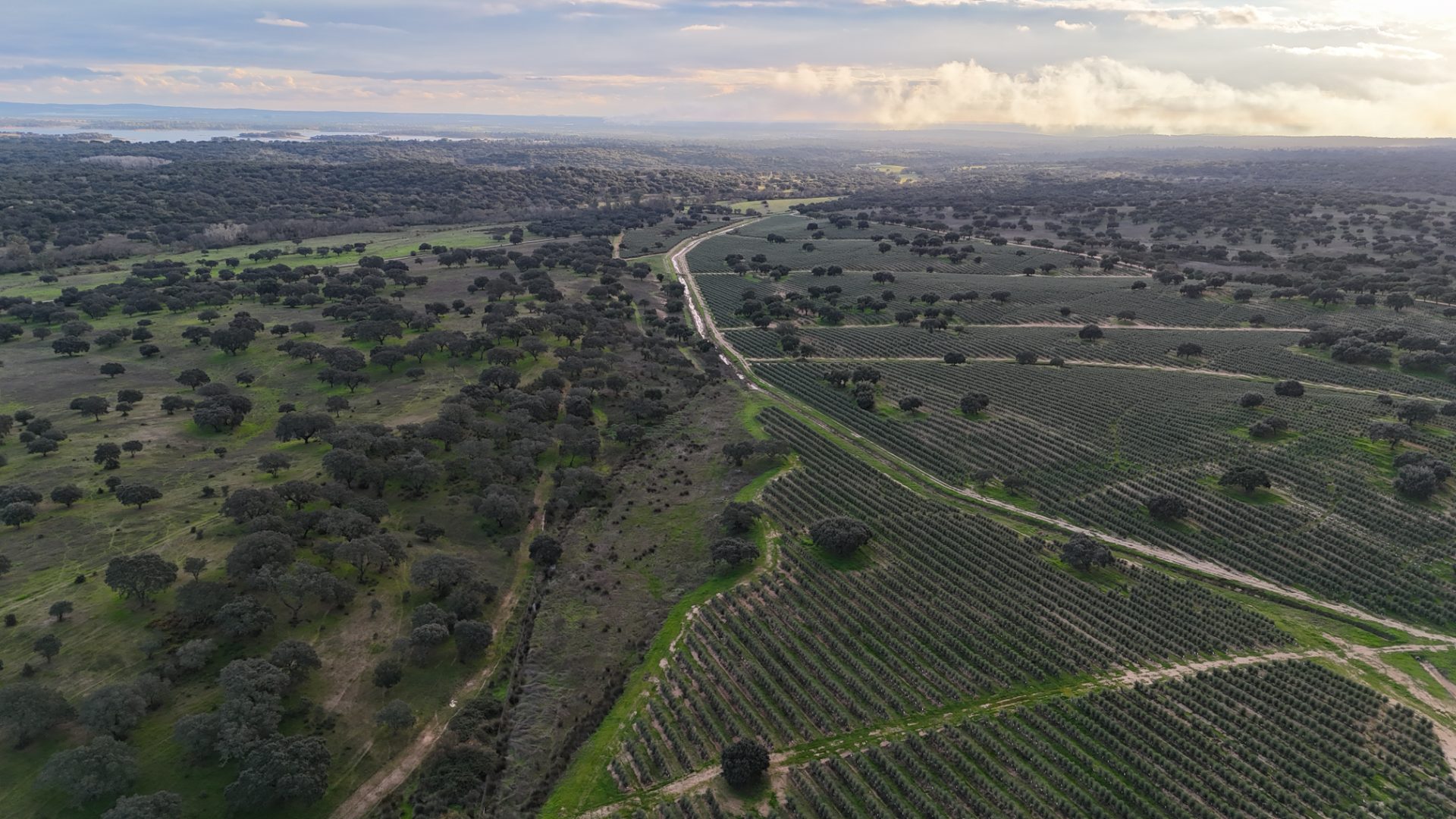
What is Regenerative Agriculture?
Despite growing interest in the concept, there is still no universally-accepted definition of what regenerative agriculture is among researchers or practitioners. One of the main splits is between those who see it in terms of specific agricultural practices (for example, no-till farming and cover cropping) and those who define it through outcomes (for example, improvements in soil health or biodiversity metrics).
Other terms (climate-smart farming and agroecology) are also used to describe similar approaches, albeit less frequently13.
The most thoughtful definitions of regenerative agriculture focus on a combination of principles, practices and systems that combine to create positive outcomes for the health of soils, ecosystems, and the climate14. Almost all definitions share a common focus on improving soil health, both through keeping soil covered and through replacing synthetic inputs (fertilisers, herbicides, and pesticides) with organic alternatives; as well as protecting and nurturing biodiversity both above and below ground.
Most definitions also note that regenerative agriculture is context specific: what works in one climate, market, and crop type (for example, on annual crops in tropical climates) will not necessarily be effective in another (for example, on perennial crops in Southern Europe).
To help us to talk clearly about what we do, Pela Terra funds have chosen to recognise and align their work to the defining principles for stewarding regenerative agriculture adopted by the European Alliance for Regenerative Agriculture (EARA)15.
Regeneration is a life-enhancing process, rather than a permanent state
A ‘regenerative’ or ‘regenerating’ farm system refers to a farm in the ‘process of regeneration’, not a farm in an assumed final state. Regeneration builds on the fundamental principle of evolution: life compounds into more symbiotic complexity when the conditions are conducive to life.
Regeneration is outcome-oriented regarding social, ecological and economic health
Regenerative agriculture is non-dogmatic. Each farmer chooses, based on a deep analysis of their context, the practices appropriate to that context. Outcomes need to be contextualized to climatic, environmental, economic and other related conditions. The development towards symbiotic interdependence on a bioregional scale is essential. Regenerative agriculture distinguishes itself through its bridging of holistic ecological improvements with highly productive agriculture. Any legitimate verification process of outcomes must demonstrate significant and continuous improvement regarding social, ecological and economic health.
Regeneration is context-specific
Initiating the regeneration process begins with a thorough recognition and understanding of a farm system’s unique context, within and beyond the farm. It involves developing a comprehensive (social, ecological and economic) starting point and an evolving vision for the system’s health and functional properties, progressing towards key outcomes that guide decision-making. There are no universally applicable or single regenerative practices; instead, there are practices that can guide regeneration within a specific context. Effective farm-level practices must align with and contribute to larger social, ecologic and economic health. Flexibility and adaptability are key in tailoring approaches to unique environmental and socio-economic circumstances.
Regeneration is systemic
Systemic regeneration unfolds as synergies/symbioses in which more soil biodiversity leads to better ecological functions, to more healthy plants, to more productivity and to other benefits, because regeneration is addressing living systems as wholes. Regeneration is not a zero-sum bargain in which agricultural productivity is traded for better socio-ecological impact of land use. Regeneration is fostered through the whole system in question, not just on the farm.
So what does this look like in our context?
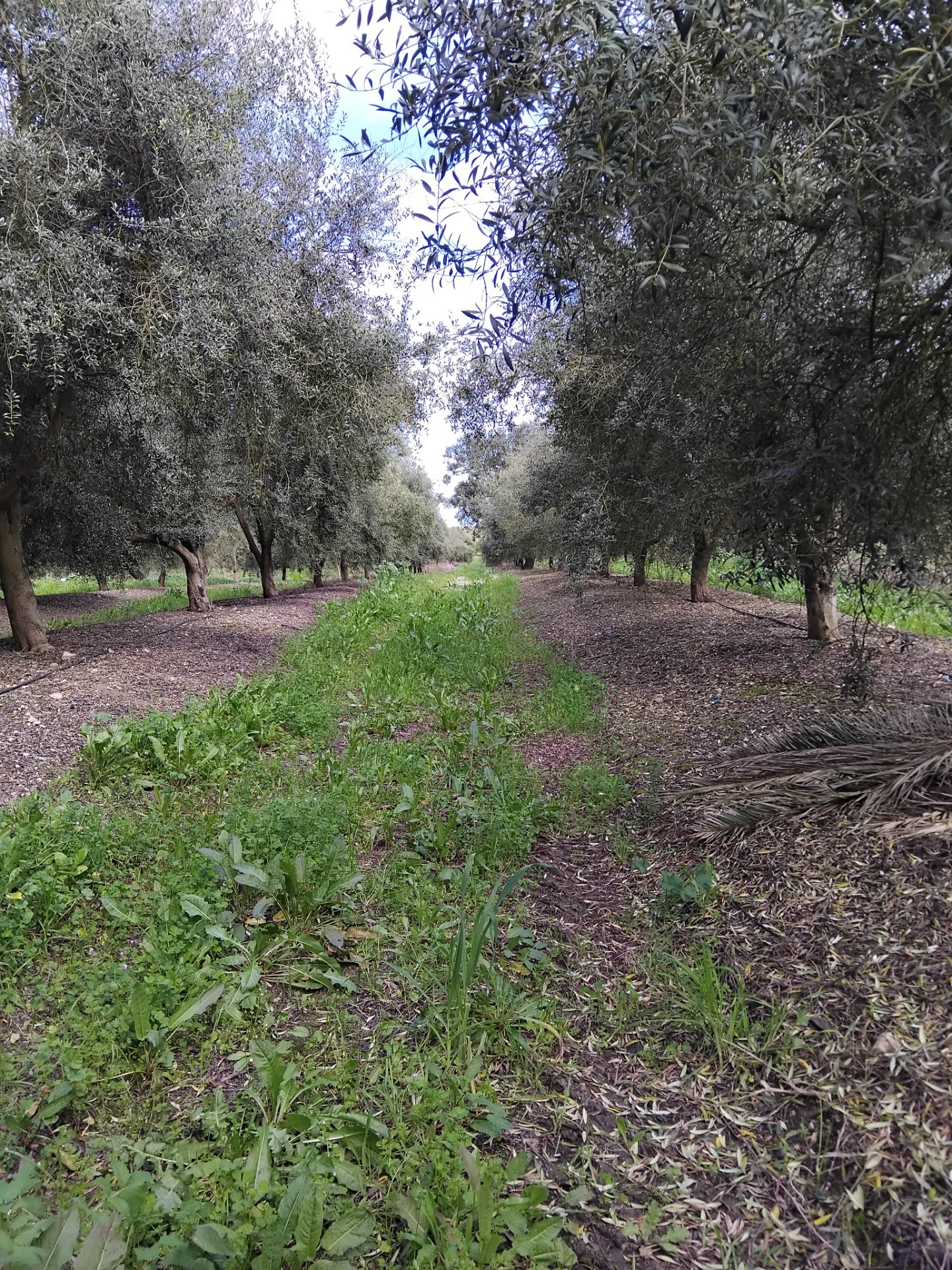
- —Planting cover crops and leaving pruning residues on the soil
- —Targeted use of soil biostimulants and inoculants
- —Mulching, including living mulch
- —Controlling and removing invasive species
- —Installing solar panels on our farms to cut GHG emissions from electricity
- —Working to reduce our fossil fuel use (for example, through making fewer passes with tractors and machinery)
- —Creating biodiverse perennial plantations in areas including the edges of dams, waterlines and hedges and flower strips – while controlling invasive species
- —Making use of integrated nutrient and pest management techniques to consistently reduce the volume of synthetic inputs used on the farms
- —Mechanical soil interventions where necessary to combat erosion and soil compaction
- —Investing in precision irrigation to allow us to apply water efficiently to reduce consumption while maximising yields
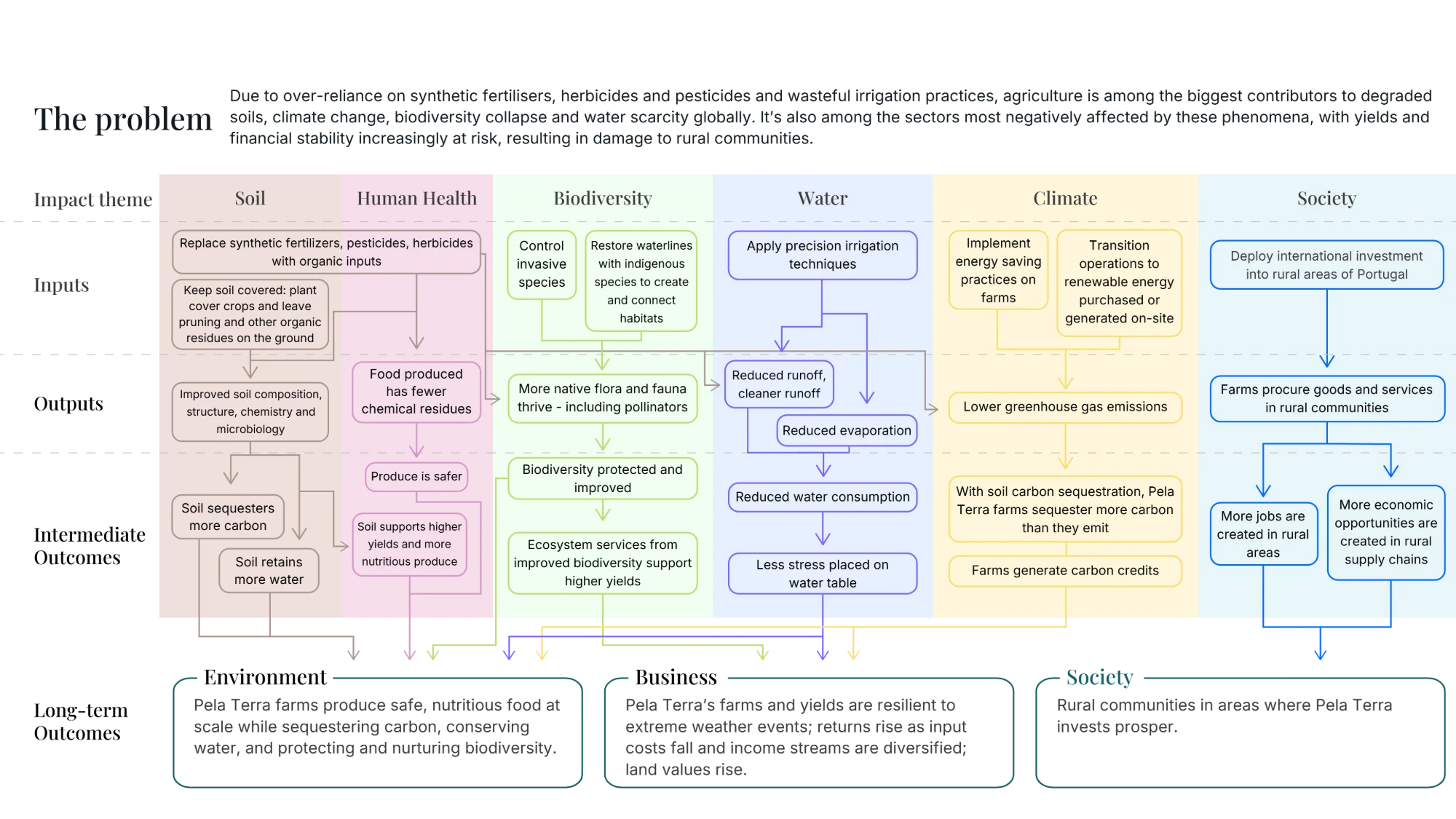
Our Theory of Change
These are the mechanisms through which Pela Terra II’s investments in regenerative agriculture create positive impact.
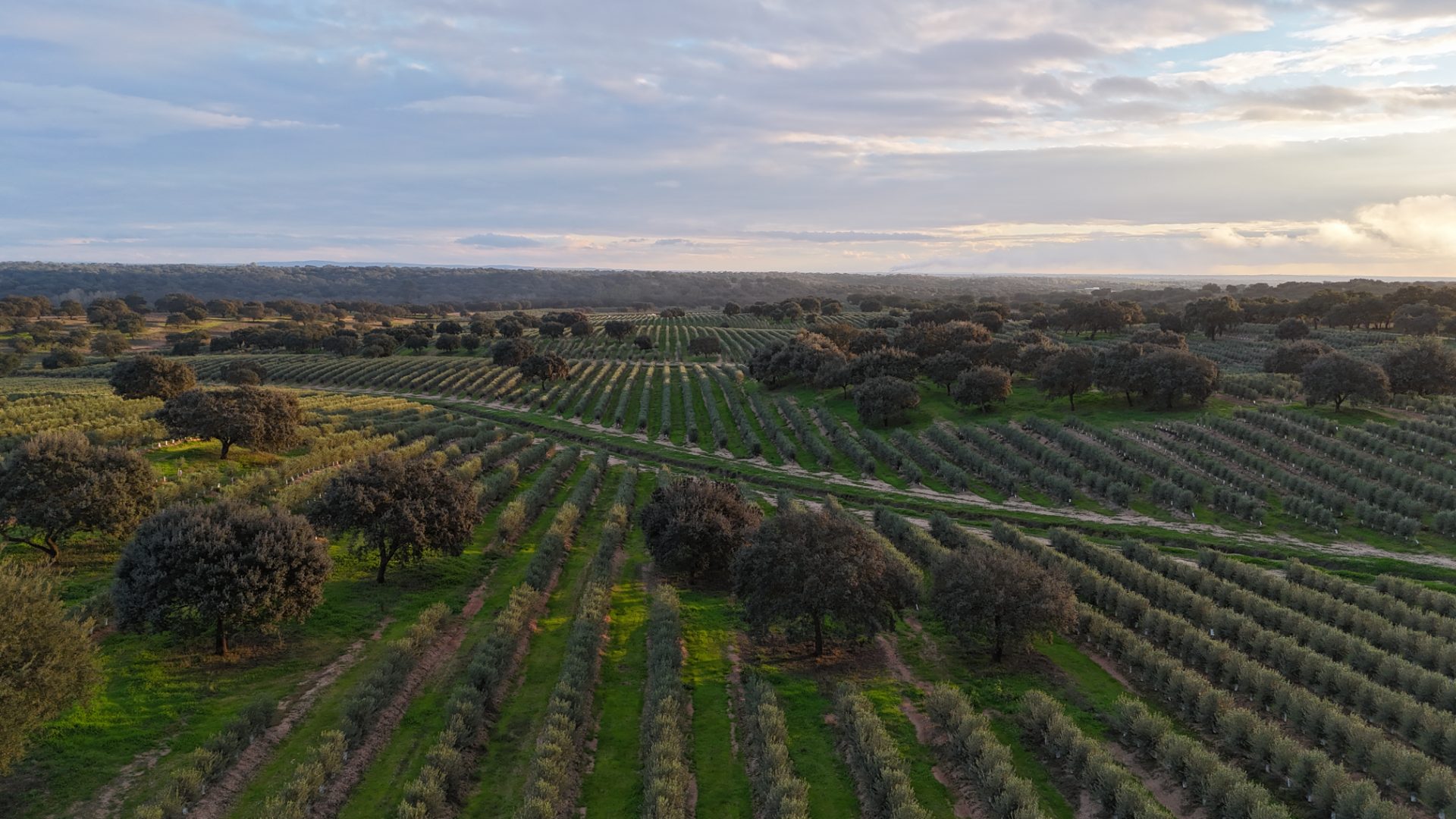
Our Investment Approach – Growing Resilience
Investment in regenerative agriculture correlates strongly with greater resilience and profitability at the farm level. Put simply, it makes bad years better and good years more profitable.
This works through three interconnected mechanisms:
Lower volatility
Conventional agriculture is highly exposed to a range of risks beyond the farm gate: fluctuating fertiliser prices, unstable energy prices, and drawn-out agrochemical supply chains - all of which are vulnerable to geopolitical shocks. By reducing dependence on synthetic inputs and producing more on-farm – through solar energy, cover crops, and organic alternatives – we aim to ensure that our farms are significantly less exposed to these pressures. Farms producing traceable, certified regenerative outcomes can also target long-term offtake agreements, providing further insulation from commodity market volatility.
Operational resilience
Healthier soils are more productive soils – and more stable ones. Research shows that regeneratively managed farms maintain around 95% of yields during drought years, compared to around 33% for conventionally managed equivalents.16 Each additional 1% of soil organic matter increases water retention by 187 m³ per hectare17 – a material advantage in Mediterranean climates increasingly defined by summer water stress.
Beyond water, healthier soils support healthier plants with greater resistance to disease18, while on-farm biodiversity – including biological pest control and diverse pollinator populations – provides a further layer of production insurance.19
Higher profitability
Fewer inputs and more stable yields translate directly into stronger margins. This is backed up by a growing evidence base across multiple geographies and crop types: for example, research from UC Davis found that super-high-density olive orchards can maintain yields and oil quality with 25–50% less synthetic nitrogen fertiliser than conventional recommendations,20 while maintaining cover crops in olive orchards has been shown to increase the abundance of natural pest predators, helping to reduce reliance on synthetic pesticides.21 Research into regenerative almond production in California shows profitability approximately twice that of conventional orchards.22 A Boston Consulting Group analysis found that regenerative practices can increase farm profitability by up to 120% compared to conventional approaches.23
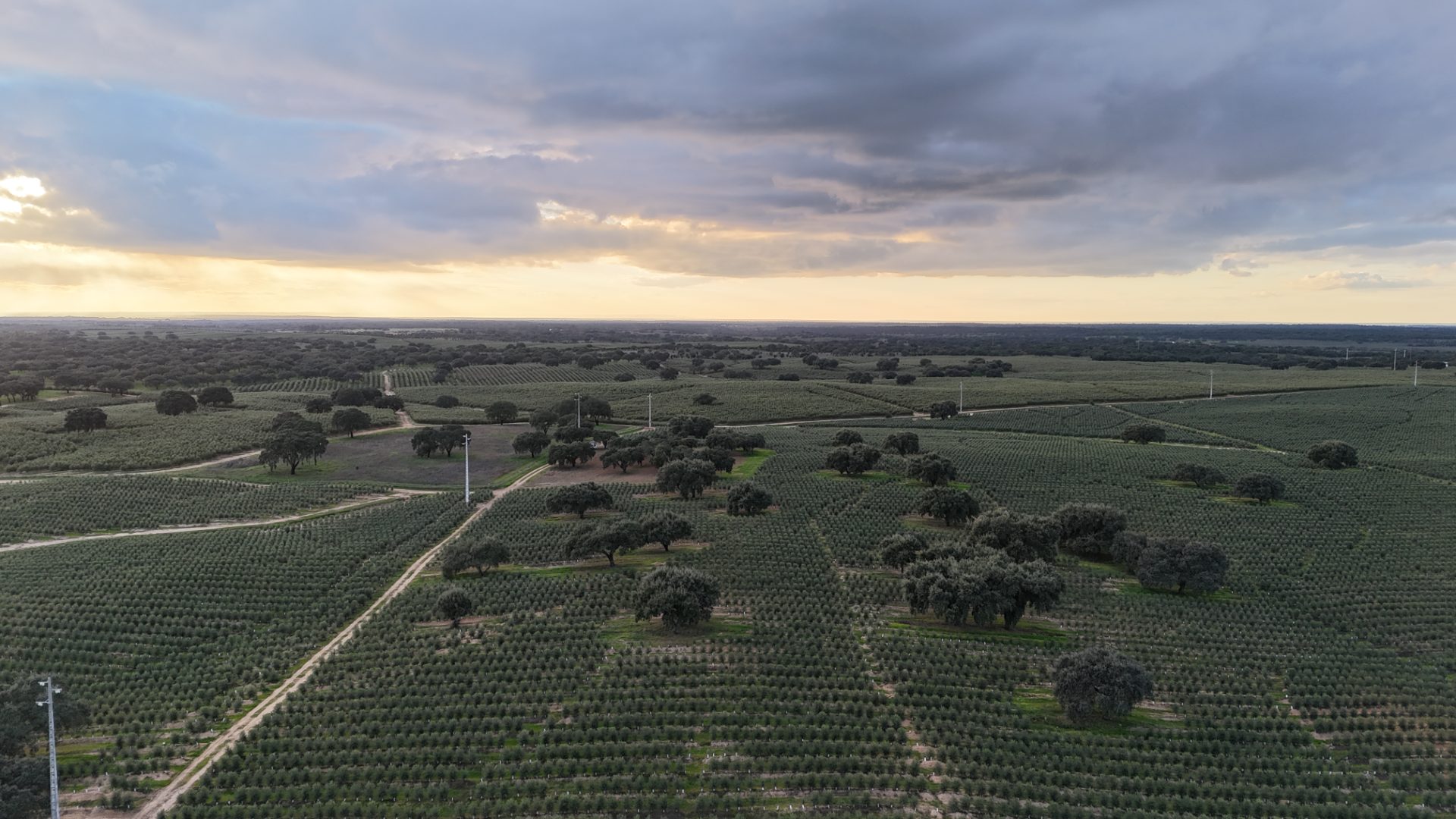
How We Measure Our Impact
In order to track the impact created through the fund's investments, Pela Terra II adheres to an impact measurement strategy that is built on three major elements:
- —Data collection and expert assessments for each property.
- —Reporting frameworks, at the fund level and the farm level
- —Third-party certification programmes.
The following section looks at each of these in more detail.
Data collection and expert assessments for each property
We collect data on the impact of our work in several ways:
- —In partnership with our farm operators, we collect data on all the inputs we make to the farms controlled by the fund - for example, fuel and energy consumption, fertiliser, herbicide and pesticide use, quantity and type of trees planted, number of employees, type of contract, etc.
- —Increasingly, we use AI-enabled software on our farms to help us understand and track our inputs at a granular level.
To help us better understand outcomes, we also work with external experts who perform detailed assessments of each farm and collect and analyse data on the ground - for example, soil samples to determine soil health and biodiversity, water quality analyses, and habitat surveys to determine what species are present.
We use drone and satellite imagery to give us a ‘top down’ picture of the properties, helping to identify areas where there are potential issues or areas of particular ecological interest.
Reporting frameworks
To help us decide which indicators are most important and help us present, analyse and compare the data we collect, we use well-respected, globally recognised frameworks. The two primary frameworks we align with at the fund level are the UN Sustainable Development Goals and the Global Impact Investing Network's IRIS+ framework.
IRIS+ was developed by the Global Impact Investing Network to be the generally accepted system for impact investors to measure, manage, and optimise their impact. It offers a thematic taxonomy based on generally accepted impact categories and themes and core metrics sets setting out the most useful indicators in each impact category.
IRIS+ is directly aligned to the UN Sustainable Development Goals (including both the top-level Goals and the targets feeding into them) and over 50 other commonly used metrics frameworks, standards and platforms.
Using IRIS+ and aligning to the UN Sustainable Development Goals allows us to benchmark the depth and quality of our impact in relation to global standards and link our work to progress towards the outcomes that the UN has decided are most relevant for the sustainable future of the world.
Starting from this year, Pela Terra II is partnering with Terra Madre to enrol our farms in their Agro Eco Assessment MRV programme, a joint venture with Climate Farmers.24
This provides a comprehensive farm-level assessment across five interdependent impact areas – soil health, biodiversity, water cycle, profitability, and social benefits – evaluated using field data, laboratory analysis, farmer surveys, and scientific literature. Scored on a standardised 1–5 scale in each category, it establishes a quantitative baseline against which each farm's regenerative progress will be tracked over time – while also allowing benchmarking against other farms, regenerative and conventional, in the same region.
Third-party certification programmes
Where relevant, we work with partner organisations who provide certifications for processes, properties and produce. These programmes help us to better measure and benchmark the impact we're creating, and also ensure that we're implementing processes that are in line with global standards and best practices.
The fund's planted estates are certified for Integrated Production. Units of the fund are also exploring the possibility of applying for the following certifications, pending further analysis of the ROI of each:
- —Certification through the Pollinator Partnership’s Bee Friendly Farming Programme.
- —Setting climate and nature targets through the Science-Based Targets Initiative.
- —Forest Stewardship Council (FSC) certification for cork forest (montado) areas.
Methodological references
In designing its impact measurement and reporting approach, the fund draws on several internationally recognised methodological references: the Global Impact Investing Network’s IRIS+ taxonomy and core metrics sets (indicator selection and benchmarking); the Impact Frontiers five dimensions of impact (framing what, who, how much, contribution and risk when defining KPIs); the GHG Protocol Corporate Standard (the Scope 1, 2 and 3 structure used for emissions accounting); and the TNFD and Science Based Targets Network frameworks (the mitigation hierarchy and action framework underpinning the biodiversity strategy). These frameworks are used as references to inform methodology; the fund does not claim formal alignment with, certification under, or assurance against any of them.
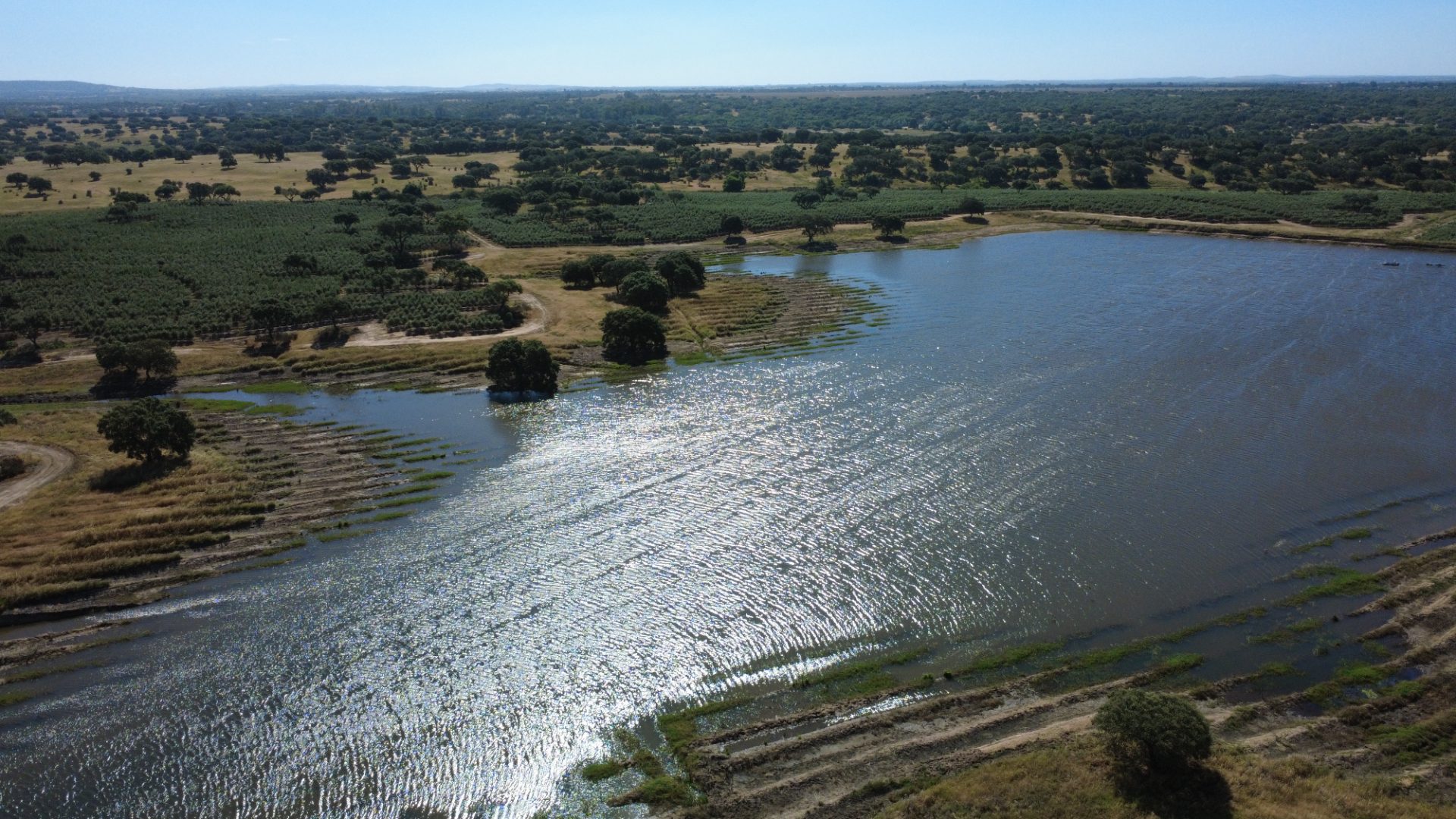
Our Six Impact Themes
Soil
Theme 01 / 06Life on earth depends on healthy soils: they are the foundation of our food systems and the basis for almost all biodiversity. When well looked after, they sequester carbon to support a resilient climate and retain up to 25 per cent of their mass in water, contributing to water security and disaster risk prevention25.
Soil is a fragile resource: one centimetre can take hundreds of years to form but be lost in a single rainstorm. It must be protected and nurtured if we are to continue to be able to grow food and benefit from the wide range of ecosystem services and other benefits it provides26.
However, conventional agriculture, through repeated tilling and heavy use of pesticides and fertilisers, is leading to the rapid degradation of soils across the globe27, placing future food production at risk, exposing populations to increased flooding, and releasing carbon into the atmosphere that further accelerates the process of climate change.
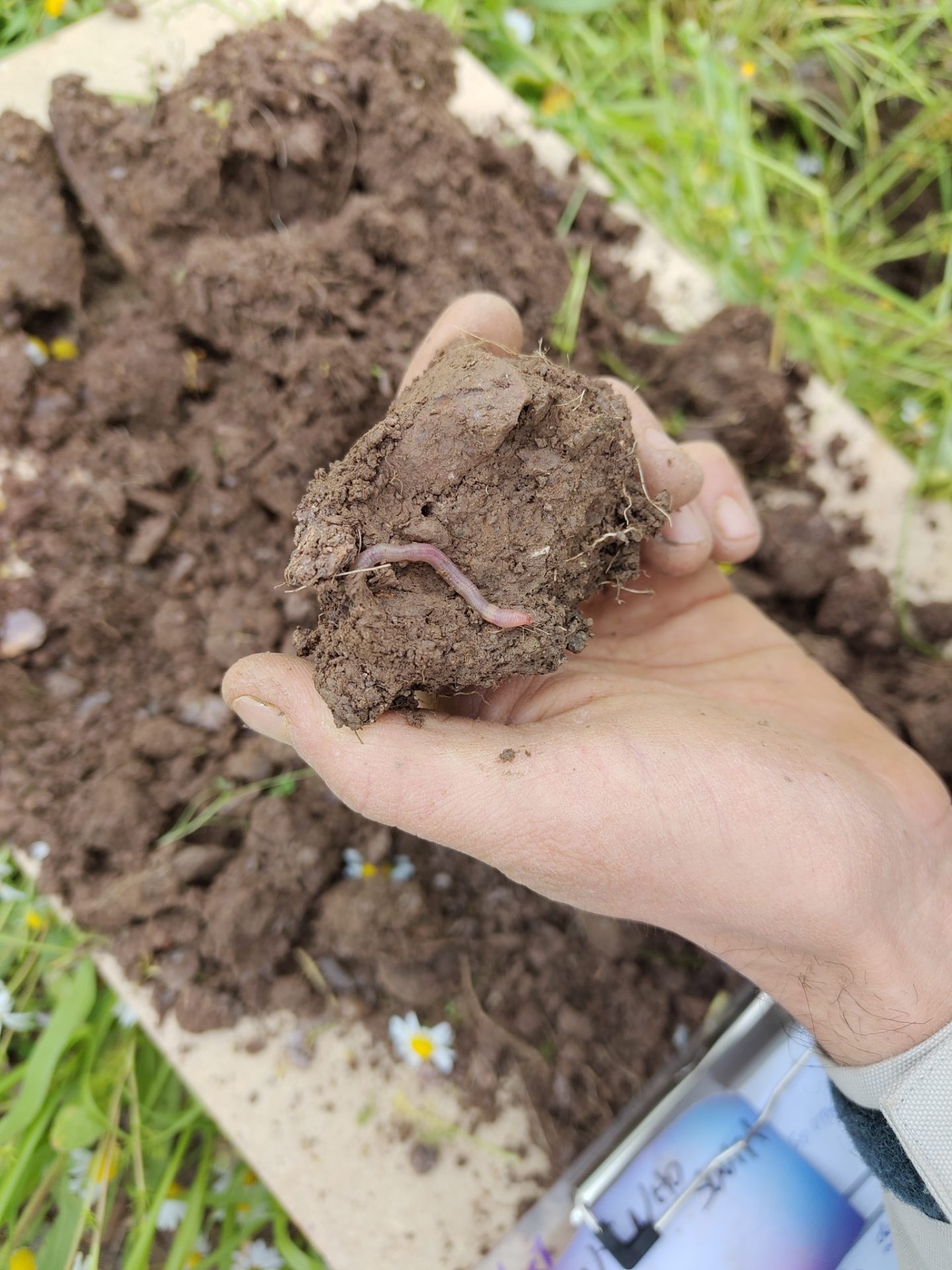
It's estimated that between 60 and 70 per cent of soils in the European Union are unhealthy, with loss of soil organic carbon and loss of soil biodiversity the top two degradation factors28. Regions where intensive agriculture is well established, such as the Alentejo, are among those worst affected29.
Soils in perennial crop systems such as orchards are often already degraded at the time of planting and tend to deteriorate further under intensive tree crop farming. Major issues include erosion, particularly on steeper farms, microbiological health degradation, chemical pollution, and compaction.
How we create impact
To improve soil health on farms in our portfolio, we work to maintain year-round soil cover, either through seeded cover crops or through encouraging the growth of naturally-occurring grasses on our interlines. We aim to maximise the presence of living roots throughout the year; enhance plant diversity; and decrease reliance on chemical inputs such as herbicides and mineral fertilisers, replacing them with organic matter applications where possible. We try as far as possible to limit tractor operations, particularly in wet conditions, to reduce soil compaction.
Through applying these techniques we can repair the damage already done to soils, conserve water, mitigate the effects of droughts and flooding, sequester carbon to help combat climate change, support biodiversity, and produce more nutritious food.
SDGs targeted
Target 15.3 — By 2030, combat desertification, restore degraded land and soil, including land affected by desertification, drought and floods, and strive to achieve a land degradation-neutral world.
Target 2.4 — By 2030, ensure sustainable food production systems and implement resilient agricultural practices that increase productivity and production, that help maintain ecosystems, that strengthen capacity for adaptation to climate change, extreme weather, drought, flooding and other disasters and that progressively improve land and soil quality.
- —Level of soil organic matter
- —Physical properties of the soil (bulk density, infiltration, soil structure and macropores, soil depth, and water holding capacity).
- —Chemical properties of the soil (electrical conductivity, reactive carbon, soil nitrate, soil pH, and extractable phosphorus and potassium).
- —Soil microbiology (earthworms, microbial biomass C and N, particulate organic matter, potentially mineralizable N, soil enzymes, soil respiration, and total organic carbon).
- —Soil conservation practices implemented (by type and total area in hectares).
- —Soil health practices (by type and total area in hectares).
Achieve an average 20% improvement in soil health indicators on all assets.
Measuring soil health
Our Soil Health KPIs are measured through our partnership with Terra Madre. Every year, they sample from the same sites on each farm. Their methodology aggregates field- and laboratory-measured indicators: Soil Chemistry draws on accredited soil lab reports (macronutrients, trace elements, pH, cation exchange capacity and base saturation); Soil Structure combines lab-measured soil organic matter with agronomist field tests (soil porosity, visual soil structure assessment, aggregate stability and hardpan depth); Soil Biology combines soil organic matter, porosity and vegetation cover with Microbiometer readings of microbial biomass and the fungus-to-bacteria ratio, plus biocide presence from the farm field book; and Plant Health draws on sap analysis of leaf nutrient levels together with disease/pest incidence and relative yield. This analysis is used to report against our four sub-KPIs for soil health. It also allows us to compare and benchmark our results against other farms across Iberia.
Water
Theme 02 / 06Water is essential for life, and is a critical input to any agricultural system. Agriculture is the biggest user of fresh water globally, consuming 72 per cent of all water withdrawals30. However, water scarcity is an increasing problem on every continent, with poorer communities worse affected.
The FAO estimated in 2020 that 3.2 billion people - almost half the world's population - lived in agricultural areas with high to very high water shortages or scarcity31. Climate change is making the situation worse: water is becoming more unpredictable, and terrestrial water storage (water held in soil, snow and ice) is depleting. Already, one fifth of the world's river basins are experiencing rapid changes in the area covered by surface waters, indicative of flooding and droughts caused by climate change32.
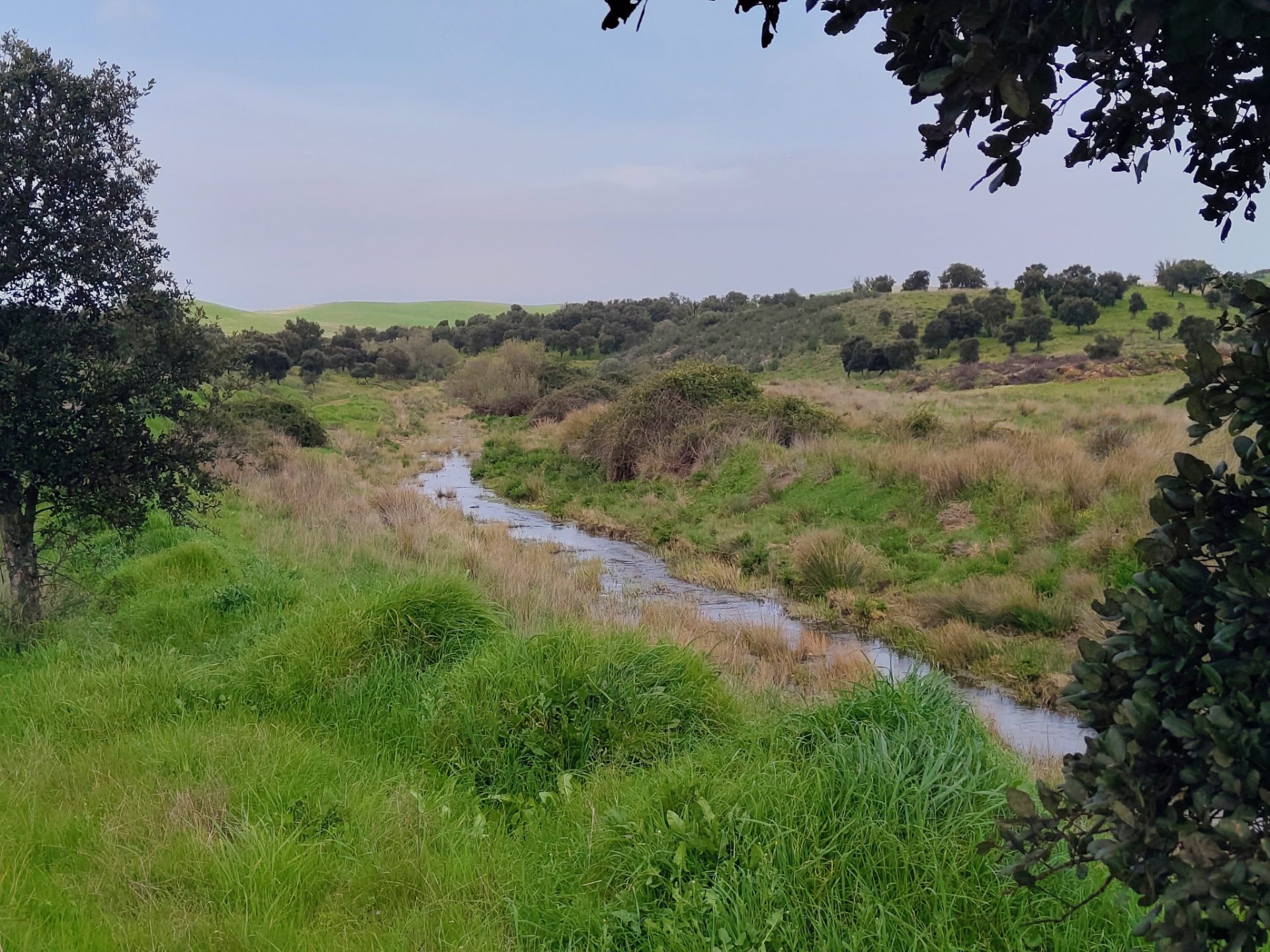
While the regions worst impacted by water stress are in Northern Africa and Western Asia, Europe is affected too, experiencing its driest summer in 500 years in 2022. In many regions of Portugal droughts are becoming more and more common, with 2022, 2023 and 2024 all bringing warnings from farmers and government of severe drought33.
However, water scarcity is only one part of the problem, with water quality also an issue. Here, too, agriculture is a contributor. Agricultural inputs such as pesticides and fertilisers often leach into streams, rivers and groundwater, resulting in the eutrophication of water bodies and loss of freshwater biodiversity. As well as being harmful to wildlife, agricultural water pollution can also have negative effects on humans, particularly in communities surrounding farms34.
How we create impact
To maximise water use efficiency, we are taking steps to minimise erosion while maximising water infiltration and soil storage. All our orchards now use modern drip irrigation systems and have been fitted with soil moisture sensors that allow precision calibration of irrigation. Increasingly, we are using AI-enabled software to help us plan and schedule irrigation.
We are also working to reduce our use of agrochemicals, and upgrading fertiliser programmes to optimise fertiliser application, allowing us to minimise the risk of leaching. We have programmes in place to plant waterlines on the farms with native plants, helping to further reduce erosion and create biodiversity corridors.
SDGs targeted
Target 6.4 — By 2030, substantially increase water-use efficiency across all sectors and ensure sustainable withdrawals and supply of freshwater to address water scarcity and substantially reduce the number of people suffering from water scarcity.
Target 12.6 — Encourage companies, especially large and transnational companies, to adopt sustainable practices and to integrate sustainability information into their reporting cycle.
Target 15.5 — Take urgent and significant action to reduce the degradation of natural habitats, halt the loss of biodiversity and, by 2020, protect and prevent the extinction of threatened species.
- —Total water use by tonne of yield
- —Level of water stress
- —Actions taken to improve farm waterlines and ditches (by type and area covered).
- —Implementation of water-saving technologies (by type and by area covered).
Achieve a 10% decrease in water wastage through more efficient irrigation.
Climate
Theme 03 / 06The Paris Agreement commits governments to holding the increase in the global average temperature to well below 2°C above pre-industrial levels, with a target of limiting the increase to 1.5°C. However, 2024 was the hottest year on record, with 2025 in second place and 2023 in third. 2025 was also the twelfth in a row in which temperatures have equalled or exceeded 1.0°C above the pre-industrial period35.
Agriculture and the global food system are significant contributors to climate change: over a third of anthropogenic greenhouse gas emissions are produced by the food system, with the largest contribution (71 per cent) coming from agriculture and changes to land use.36 37
Agriculture is also among the sectors most at risk from unpredictable weather events caused by changing climate.
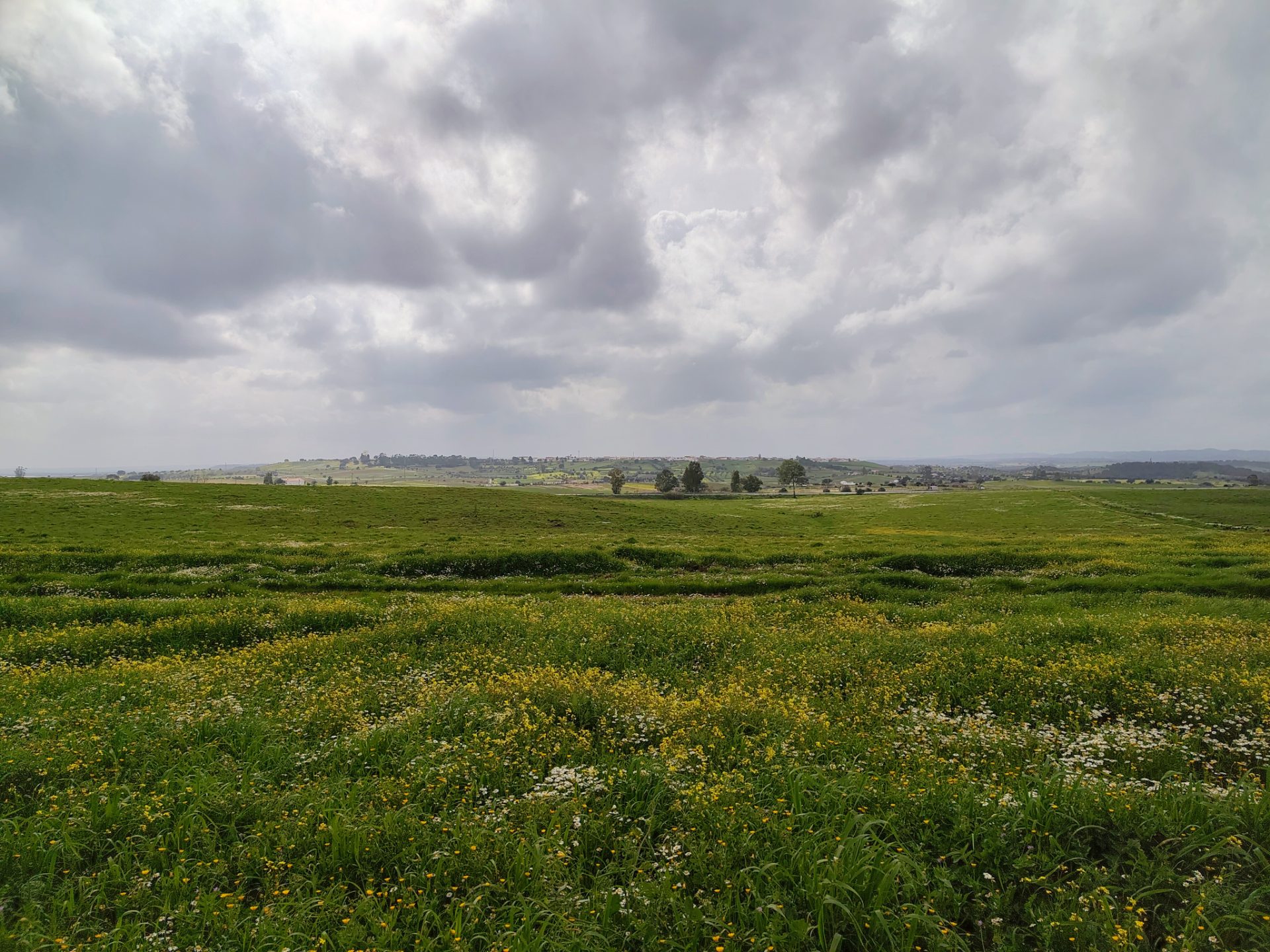
Most of the greenhouse gas emissions produced through agriculture are attributable to two main factors: the overuse of fertilisers, leading to significant emissions of greenhouse gases including nitrous oxide and methane; and tillage, which leads to carbon sequestered in the soil being converted to atmospheric carbon38.
Tree crop systems on their own have the potential to sequester significant amounts of carbon in their wood, provided they are managed well throughout their whole lifecycle.
More importantly, however, soil is a natural carbon sink. Globally, soils store three to four times the amount of carbon locked into vegetation and between two and three times the amount in the atmosphere39. Research has estimated that soil carbon represents 25 per cent of the potential of natural climate solutions, of which 40 per cent can come from protection of existing soil carbon and 60 per cent from rebuilding depleted stocks40.
How we create impact
We are rolling out practices such as cover cropping and reduced tillage on farms in the portfolio, with the aim of improving soil health and enhancing carbon storage, protecting carbon already sequestered and promoting further sequestration41.
We are reworking fertilisation protocols across all the farms in line with our farm transition plans, allowing us to significantly reduce our use of synthetic fertilisers and manage nitrogen volatilisation – helping us cut our emissions of nitrous oxide and methane.
We’re also working to cut greenhouse gas emissions from fossil fuel use (for example, through minimising tractor operations in orchards and building out solar installations). Our aim is to eliminate all greenhouse gas emissions from electricity use in the next 1–2 years.
SDGs targeted
Target 7.2 — By 2030, increase substantially the share of renewable energy in the global energy mix.
Target 13.2 — Integrate climate change measures into national policies, strategies and planning.
- —Scope 1, 2 and 3 emissions (as defined by the GHG Protocol Corporate Standard).
- —Area of trees planted.
- —Decrease in use of artificial fertilisers.
- —Carbon dioxide sequestered.
- —Energy purchased, from renewable and non-renewable sources.
- —Renewable energy generated.
Reduce synthetic fertiliser inputs by 30% on a per-hectare basis.
Achieve net negative greenhouse gas emissions on a per hectare level.
Biodiversity
Theme 04 / 06Biodiversity is essential for healthy ecosystems that provide vital services like food, clean water, fertile soils, climate regulation, and crop pollination. Portugal has a rich biodiversity, with over 3,500 plant species and numerous important animal species. However, agricultural intensification, land abandonment, urbanisation, and climate change pose major threats to this biodiversity. Only 26.5 per cent of species and 23.7 per cent of habitats currently have a favourable conservation status in Portugal42.
Conventional agriculture contributes significantly to biodiversity loss through habitat destruction, pesticide and herbicide use, promoting monocultures, and soil degradation. The expansion of crop and grazing lands is the biggest driver of terrestrial biodiversity loss globally43. High levels of pesticide use cause parallel declines in insect, bird and plant biodiversity in areas of high agricultural intensity44.
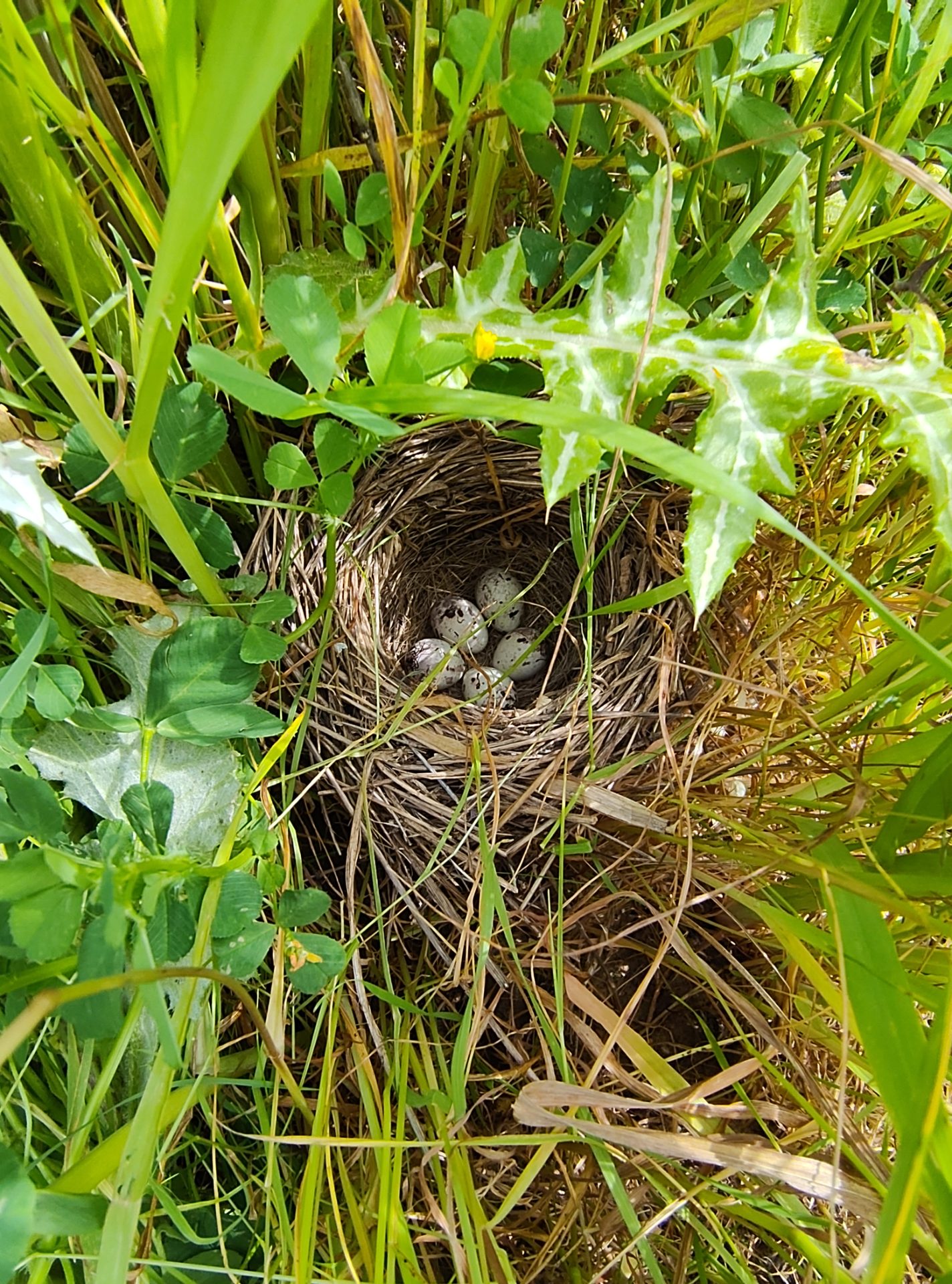
Intensive tree crop systems simplify the natural landscape compared to natural and semi-natural ecosystems (such as forests, montados, or natural prairies). However, regenerative approaches that integrate a variety of trees, plant species and even livestock on the same land in a sustainable way have been shown to substantially increase biodiversity and environmental benefits compared to conventional intensive systems45.
Setting aside areas as ecological corridors and biodiversity hotspots is an important aspect of this approach. Restoring native vegetation, hedgerows, ponds and other semi-natural areas has proven benefits for pollinator conservation, pest control, soil health and overall biodiversity.
How we create impact
On our properties we aim to balance agricultural production with biodiversity conservation measures. We are protecting and restoring existing ecological areas (such as montados and riparian zones). At the fund level we currently set aside 8.6 per cent of the land we manage (70 hectares) for this purpose.
In line with our transition plan for each farm, we are also working to significantly reduce the use of herbicides and pesticides, helping to preserve existing biodiversity.
SDGs targeted
Target 15.5 — Take urgent and significant action to reduce the degradation of natural habitats, halt the loss of biodiversity and, by 2020, protect and prevent the extinction of threatened species.
Target 15.a — Mobilise and significantly increase financial resources from all sources to conserve and sustainably use biodiversity and ecosystems.
Third-party certifications
We are working towards recognition of our biodiversity work through the Science Based Targets Network's emerging targets for nature programme and through the Pollinator Partnership's Bee Friendly Farming programme, and Olivum Sul's Programa de Sustentabilidade e Azeite do Alentejo.
- —Area set aside and managed for biodiversity (total area and percentage of total land controlled).
- —Flora species observed (including which are RELAPE – Rare, Endemic, Local, At risk, Protected or Endangered).
- —Fauna observed (including which are of high conservation interest).
- —An assessment of habitat health / condition, to be delivered by an external provider.
- Reduce herbicide use by 30%.
- Reduce pesticide use by 20%.
- Achieve net positive biodiversity for all assets (improvement vs. baseline).
- Set aside at least 5% of the total area of land under our management and manage primarily for biodiversity.
How we assess biodiversity on our farms
Every farm in the fund was baselined shortly after acquisition by NBI, a Portuguese consultancy specialising in natural capital and biodiversity assessment. NBI’s agro-ecological value matrix scores each property’s biodiversity through multiple lenses, pairing every numeric score with a written rationale. Light-touch reassessments during the fund’s lifetime will track progress and flag where course-correction is needed, before a full reassessment at fund close, using the same agrological value matrix to give us a direct comparison with the baseline.
Human Health
Theme 05 / 06Although global production of calories has kept pace with population growth in recent decades, the FAO still estimates that 8.2 per cent of the world's population – around 673 million people – suffered from chronic hunger in 202446. Many more, up to two billion, are affected by hidden hunger, meaning they consume low-quality diets leading to micronutrient deficiencies, obesity, and non-communicable diseases (NCDs). In Europe, NCDs are responsible for 90 per cent of deaths and 80 per cent of healthcare costs; globally, unhealthy diets pose a greater risk to morbidity than unsafe sex, alcohol, and tobacco use combined47 48.
Part of the problem is that modern conventional agricultural systems are producing food which is less healthy than ever before. A reliance on crop varieties selected for yield above other factors and a deterioration in soil nutrient levels have resulted in falls in nutrient density of produce of up to 38% since 195049 50 51. The effects of climate change further exacerbate the issue: more carbon dioxide in the atmosphere also makes food less nutritious by increasing the synthesis of carbohydrates and decreasing the concentration of proteins and micronutrients52.
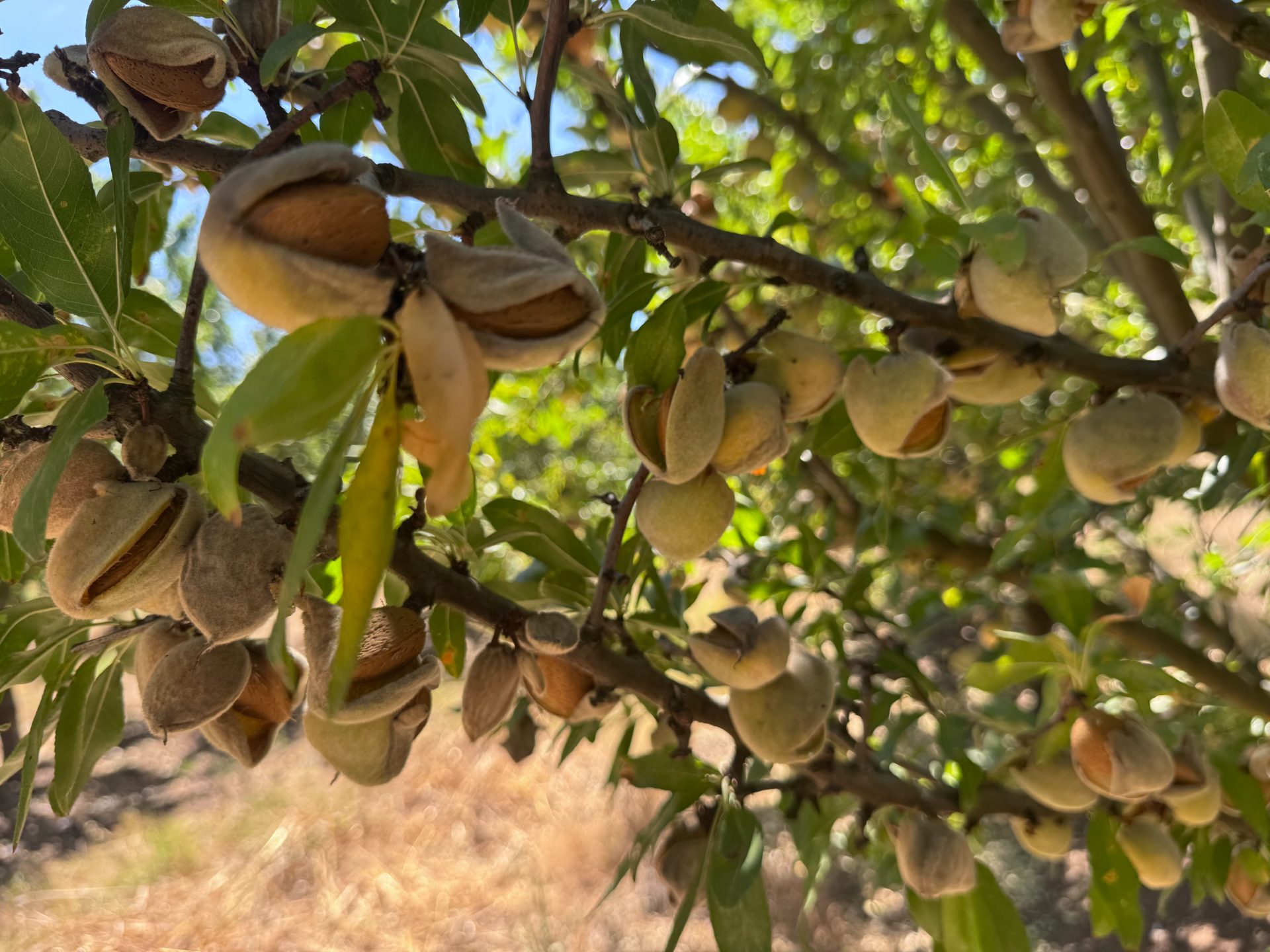
In short, our current food systems are not only damaging the planet; they are damaging the people they feed. It is therefore imperative that we reorient them towards providing sustainable, healthy diets – focussing on producing high quality, nutritious food with a low environmental impact.
A growing evidence base connects regenerative agriculture with improved human health outcomes. This linkage has two main mechanisms: first, healthier soil can lead to more nutrient-dense produce53 54. Secondly, lower use of chemical inputs means less potentially harmful residues remain on the produce – as well as fewer risks for those who work on the land and the communities which surround farms55.
How we create impact
In line with our transition plans, we have begun rolling out practices on the farms aimed at improving soil health, which we expect to lead to an improvement in the nutrient density of the produce we grow. We’re also working to reduce chemical inputs and replace them with biological inputs, which should result in fewer pesticide residues on produce.
Through our involvement in the Arbo-Innova research project in partnership with AgroSystemic and RHEA, we have baselined levels of chemical residues on our farms and will monitor them regularly.
SDGs targeted
Target 2.1 — By 2030, end hunger and ensure access by all people, in particular the poor and people in vulnerable situations, including infants, to safe, nutritious and sufficient food all year round.
Target 12.3 — By 2030, halve per capita global food waste at the retail and consumer levels and reduce food losses along production and supply chains, including post-harvest losses.
Target 3.9 — By 2030, substantially reduce the number of deaths and illnesses from hazardous chemicals and air, water and soil pollution and contamination.
- —Nutrient density of produce grown on farms
- —Level of chemical residues on produce at harvest.
- —Partnerships for research and dissemination of new methods for regenerative and/or sustainable farming.
Achieve a 10% increase in nutrient density levels of all produce at harvest.
Reduce pesticide residues on all produce at harvest to under 50% of the EU's Maximum Residue Limits (MRLs).
Society
Theme 06 / 06Across Portugal, rural areas are often those which are most disadvantaged. For several decades, young people have left rural areas looking for better paid work in urban centres, resulting in challenges for those who remain, including withdrawal of basic services56.
Agricultural work, once a source of employment for many, is increasingly carried out by immigrants who are often poorly integrated into communities and vulnerable to exploitation57.
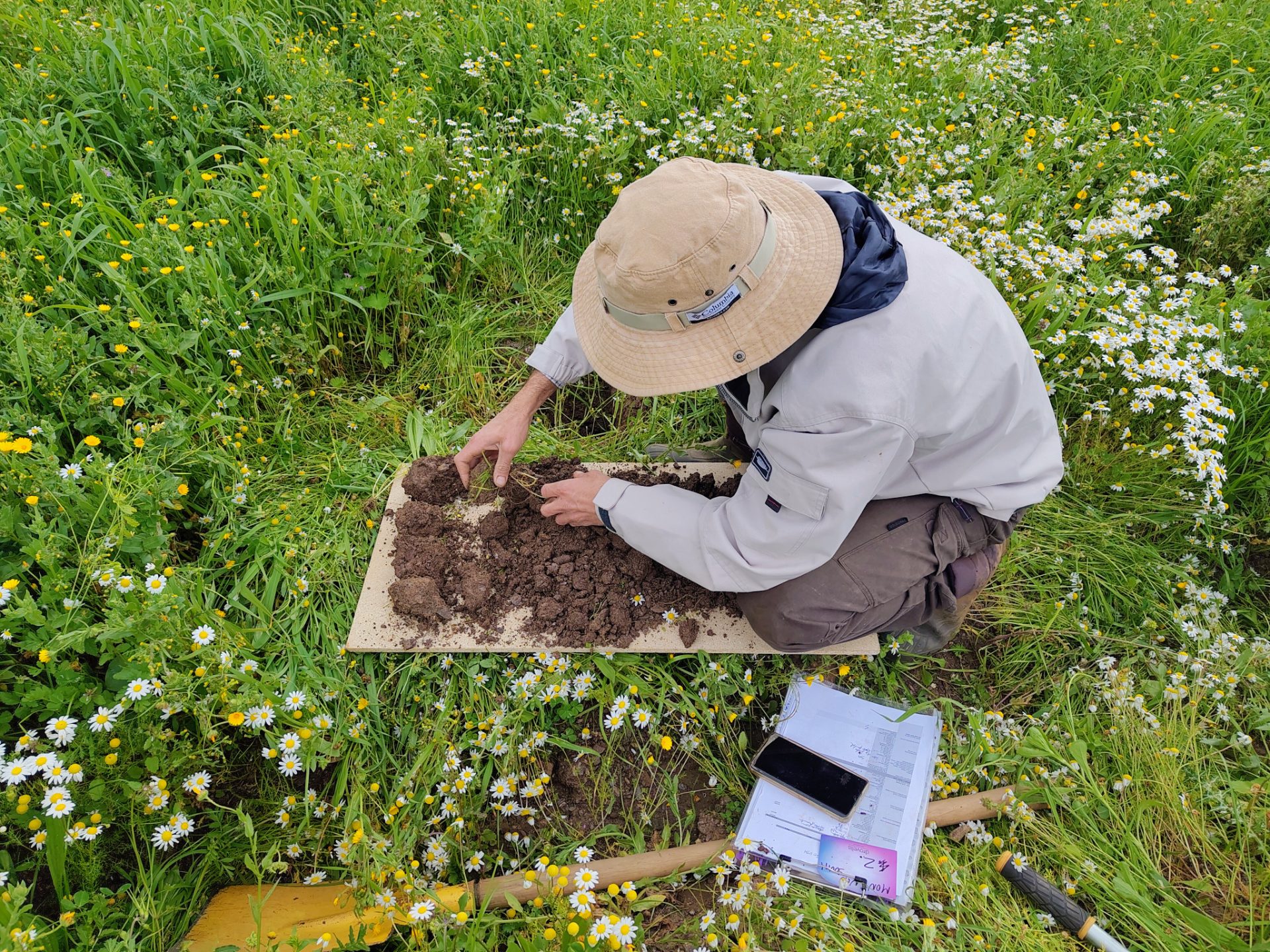
While multiple government programmes have targeted funds at areas of low population density, private investment has historically been concentrated in the large cities and along the coast, meaning the development of Portugal's interior has often lagged behind that of other areas.
How we create impact
The fund is committed to ensuring good working conditions free from exploitation for all those we come into contact with across our supply chain. Through channelling international investment to rural areas of the country where it is most needed, our approach helps to support the regeneration of rural communities through supply chain investments and job creation.
The farmers and land managers we work with have many years of experience but are often unfamiliar with the latest international best practice in sustainable and regenerative farming techniques. By bringing on board consultants and partners (both Portuguese and international) we support them to integrate new methodologies and practices into their work, which in turn can be rolled out across other properties they work on.
We also work to build partnerships with universities and research organisations in Portugal and internationally to support further innovation and investment into the economies of rural areas. Our approach is collaborative: we share results and data proactively and aim to leverage our own learning to drive change in the wider sector.
SDGs targeted
Target 8.8 — Protect labour rights and promote safe and secure working environments for all workers, including migrant workers, in particular women migrants, and those in precarious employment.
- —Percentage of capital invested in areas of low population density.
- —Number and type of jobs created.
- —Total investment in community and other social programmes.
- —Training / behaviour change for partners / farm managers.
- —Actions taken to promote impact investing in Portugal.
Make 100% of our capital investments in rural areas of Portugal.
Create 6 good jobs in rural areas of Portugal.
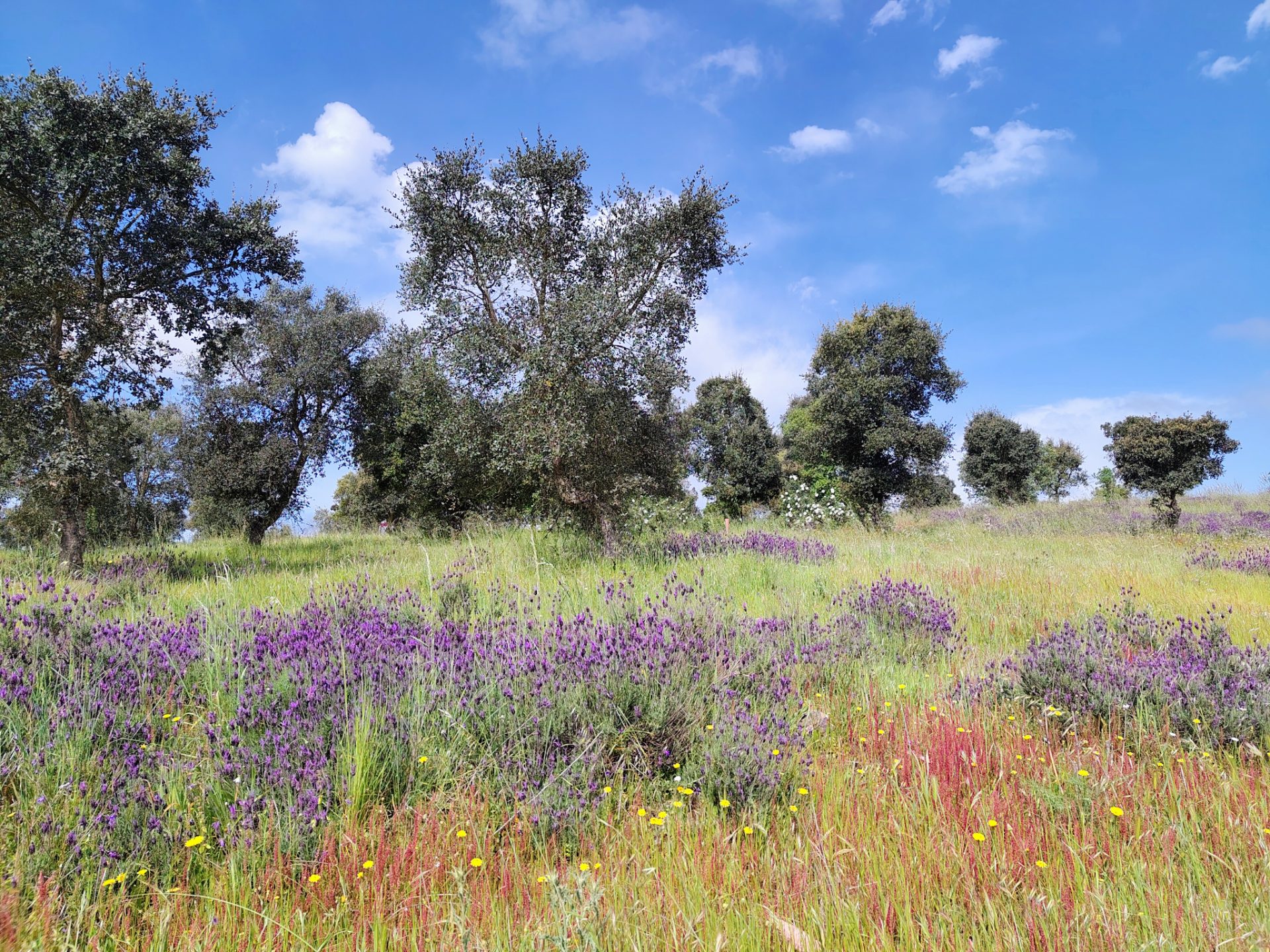
Deep Dive: Biodiversity Baselines on New Assets acquired during the Reporting Period
As part of the fund’s baseline assessment, independent ecologists carried out detailed biodiversity and agroecological surveys on the two assets acquired during the reporting period — Herdade de Meirinho and Herdade de Montinho & Monte Migueis. These deep dives establish the ecological baseline against which future progress will be measured, mapping habitats, flora and fauna, and scoring each property on an Agroecological Value Matrix.
Herdade de Meirinho
Amandel · Serpa, Alentejo
During the course of the baseline assessment, ecologists visited Herdade de Meirinho to develop a clear picture of the existing state of biodiversity and overall agroecological value on the property. The following section presents a summary of their most important findings.
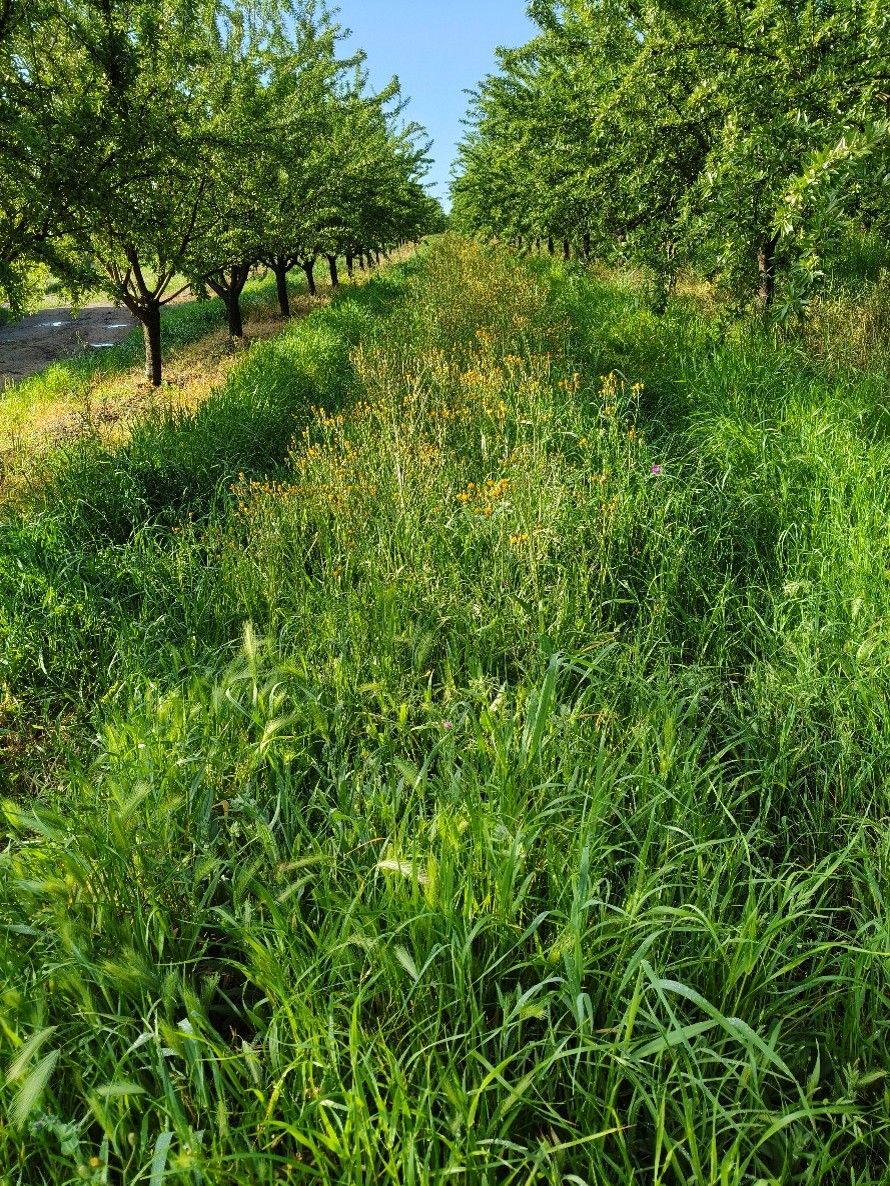
Summary
| Category | Indicator | Value |
|---|---|---|
| Habitats & Landscape | Percentage of semi-natural area | 2.6% |
| Percentage of semi-natural area that corresponds to HNVA | 0 | |
| Number of Natura 2000 network habitats present | 5 | |
| Flora | Number of flora species | 102 |
| Percentage of flora species of conservation interest | 7.8% | |
| Fauna | Number of bird species | 48 |
| Number of mammal species | 5 | |
| Number of reptile species | 5 | |
| Number of amphibian species | 4 | |
| Percentage of fauna species of conservation interest | 22.4% |
Habitats
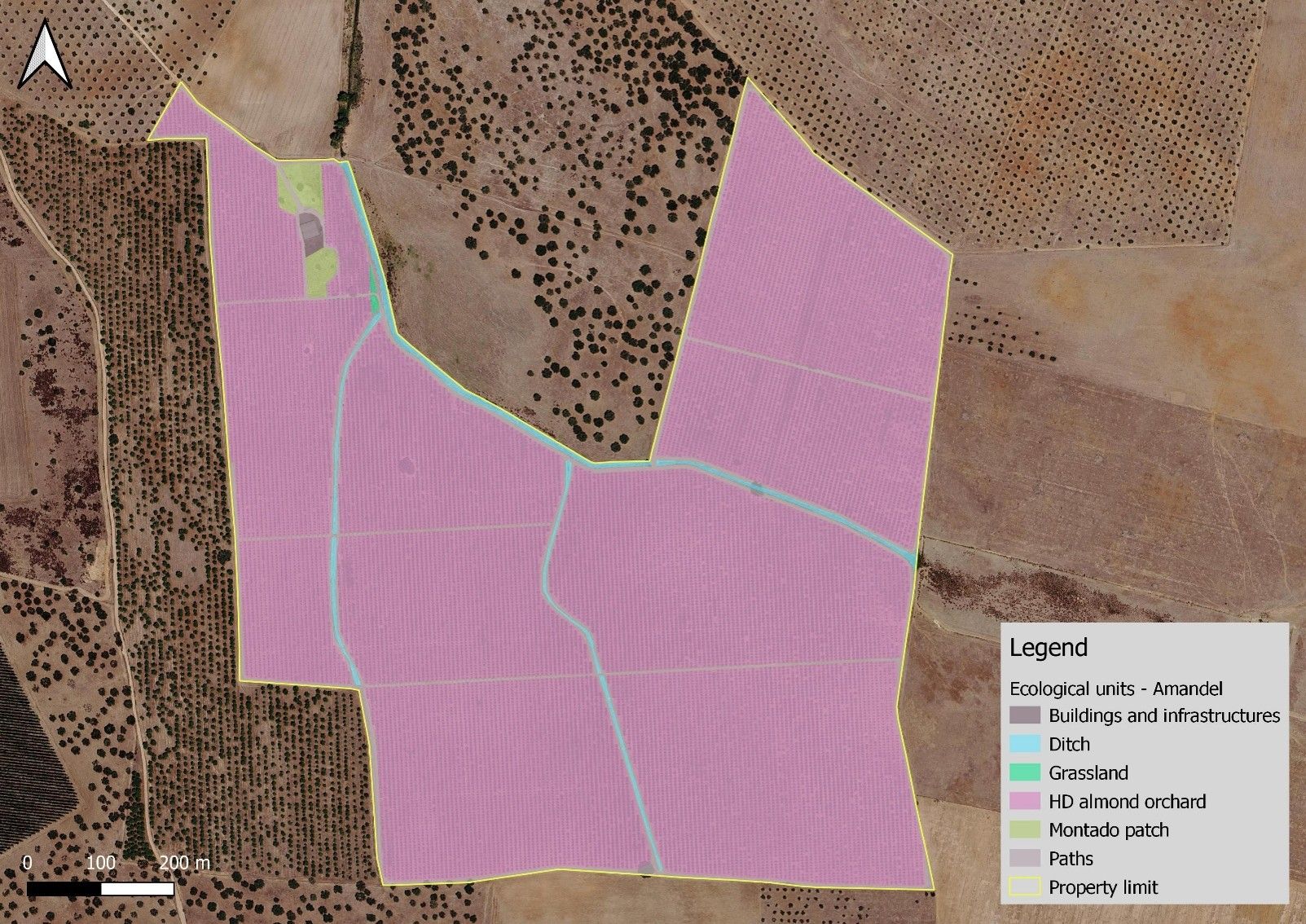
The habitats on the property were assessed based on observations during a site visit in April 2026, knowledge of the region, and bibliographic analyses. While the overall levels of biodiversity were assessed as relatively high for an orchard of this type, only 2.6 percent of the land is made up of semi-natural areas.
A total of five habitats were identified — three present and two vestigial — together with one further potential habitat. One of the habitats present, the pseudo-steppe with grasses and annuals (6220*), is a priority habitat for conservation.
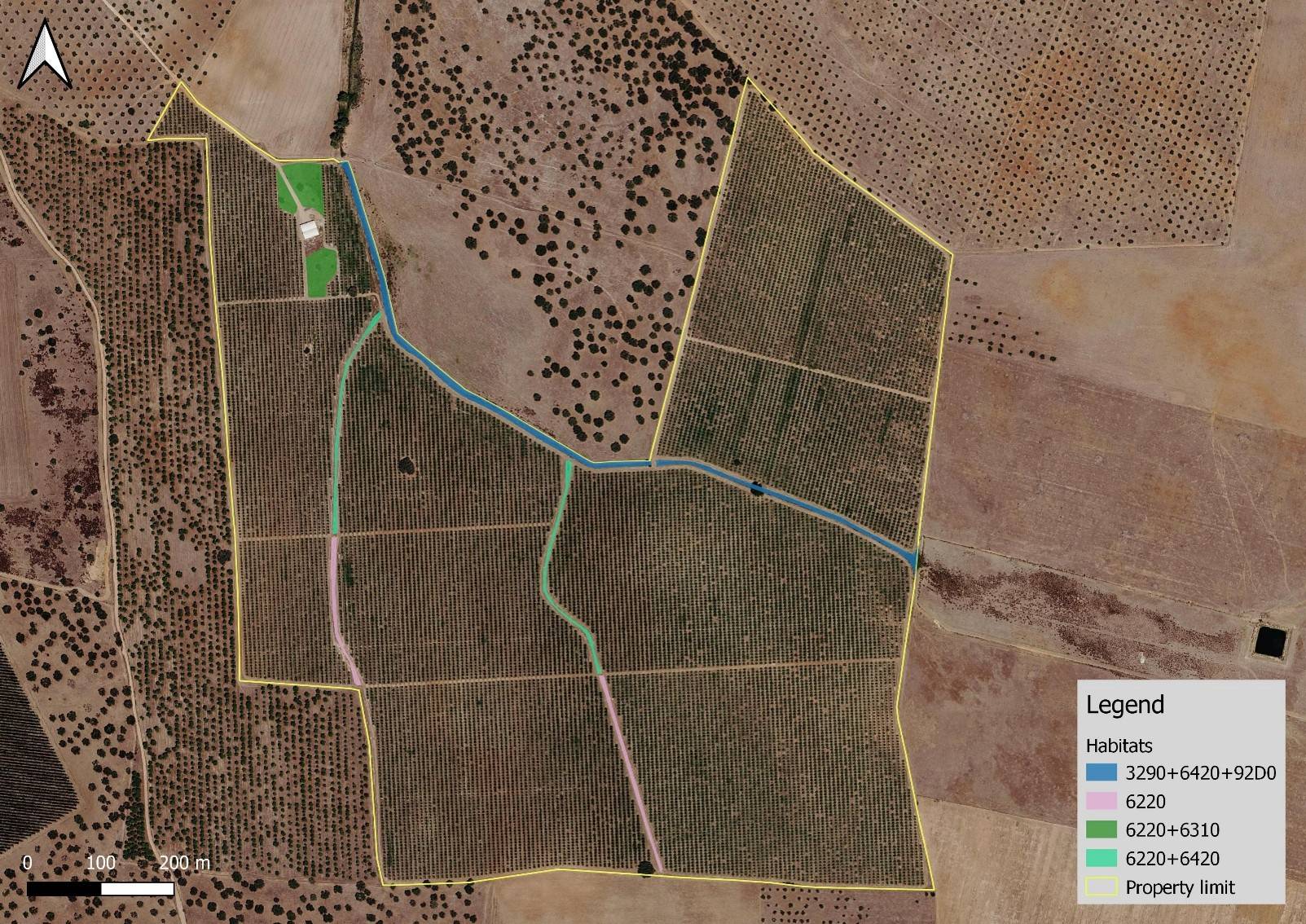
The map shows the distribution of the habitats on the property, along with management actions for each.
The following table gives details of the types of habitat on the property along with their classification according to the Natura 2000 protected areas network58
| Element | Habitat | Common name | RN2000 code | Relevance | Conservation status | Tendency 3–5 yrs · without measures | Tendency 3–5 yrs · with restoration & conservation | Management actions |
|---|---|---|---|---|---|---|---|---|
| Water | Temporary mediterranean water streams from Paspalo-Agrostidion | Temporary stream | 3290 | Present | Amber | Continued decline, with a high risk of local disappearance. | Stabilisation and gradual recovery of channel vegetation and ecological function. | Maintain an uncultivated buffer; exclude harrowing, machinery and agrochemical inputs; retain natural flow and channel form; control invasives; revegetate eroded banks with local native species. |
| Water habitat | Salix alba and Populus alba galleries | Riparian woodland | 92A0 | Potential | Red | No gallery recovery; the remaining riparian potential continues to decline. | Gradual establishment of a discontinuous native riparian gallery and improved connectivity. | Protect the channel and buffer; establish locally appropriate Salix spp., and, where suitable, Fraxinus angustifolia; use local provenance; control invasives and browsing. |
| Meridional river intermittent galleries (Nerio-Tamaricetea e Securinegion tinctoriae) | "Barranco" | 92D0 | Vestigial | Red | Continued decline, with probable loss of the remaining fragments. | Stabilisation and gradual expansion of native riparian thickets. | Exclude cultivation and mechanical clearing; retain channel dynamics; restore native oleander and tamarisk thickets in suitable reaches; control invasives and browsing. | |
| Mediterranean tall humid grasslands | Wet grassland | 6420 | Present | Amber | Declining due to harrowing, drainage and loss of seasonal soil moisture. | Stable to improving, with recovery of wet-grassland structure and function. | Exclude harrowing, drainage and agrochemicals; maintain seasonal wetness and a buffer; use late mowing or light grazing after seed set. | |
| Earth | Pseudo-steppe with grasses and annuals | Perennial grassland | 6220* | Present | Amber | Stable to declining, with reduced diversity under intensive soil and vegetation management. | Stable to improving, with greater floristic diversity, soil cover and ecological function. | Avoid ploughing, fertilisation, reseeding, irrigation and herbicides; maintain light seasonal grazing or late mowing; retain a heterogeneous patch mosaic. |
| Grassland habitat | Dehesas/Montados with evergreen Quercus spp. | Montado | 6310 | Vestigial | Red | Continued decline, with likely disappearance as a recognisable habitat. | Early structural recovery; full montado development will require longer than 3–5 years. | Protect remaining Quercus and regeneration; plant connected local-oak nuclei with guards and establishment watering; avoid tillage; use low-intensity adaptive rotational sheep grazing. |
Flora and Fauna
In total, 102 species of flora were identified on Herdade de Meirinho, of which eight are classified as RELAPE (Rare, Endemic, Local, At risk, Protected or Endangered) – 7.8% of the total. This is a low proportion, below the 20–25% range typical of much of mainland Portugal. Among the RELAPE species is the rare Convolvulus meonanthus, found in the inter-rows of the high-density almond orchard.
Seventy-six species of fauna were detected – 62 vertebrates (48 birds, 5 mammals, 5 reptiles and 4 amphibians) and 14 invertebrates – of which 17 are of conservation interest (22.4%). These include nine bird species protected under Annex I of the Birds Directive; the Eurasian otter (Lutra lutra), the Iberian mantis (Apteromantis aptera) and the Horseshoe whip snake (Hemorrhois hippocrepis), protected under the Habitats Directive; and, among the Iberian-endemic species, the European rabbit (Oryctolagus cuniculus), the Iberian mantis and the Western Iberian wall lizard (Podarcis virescens).
Details of the RELAPE flora and of fauna of conservation interest are given in the tables below.
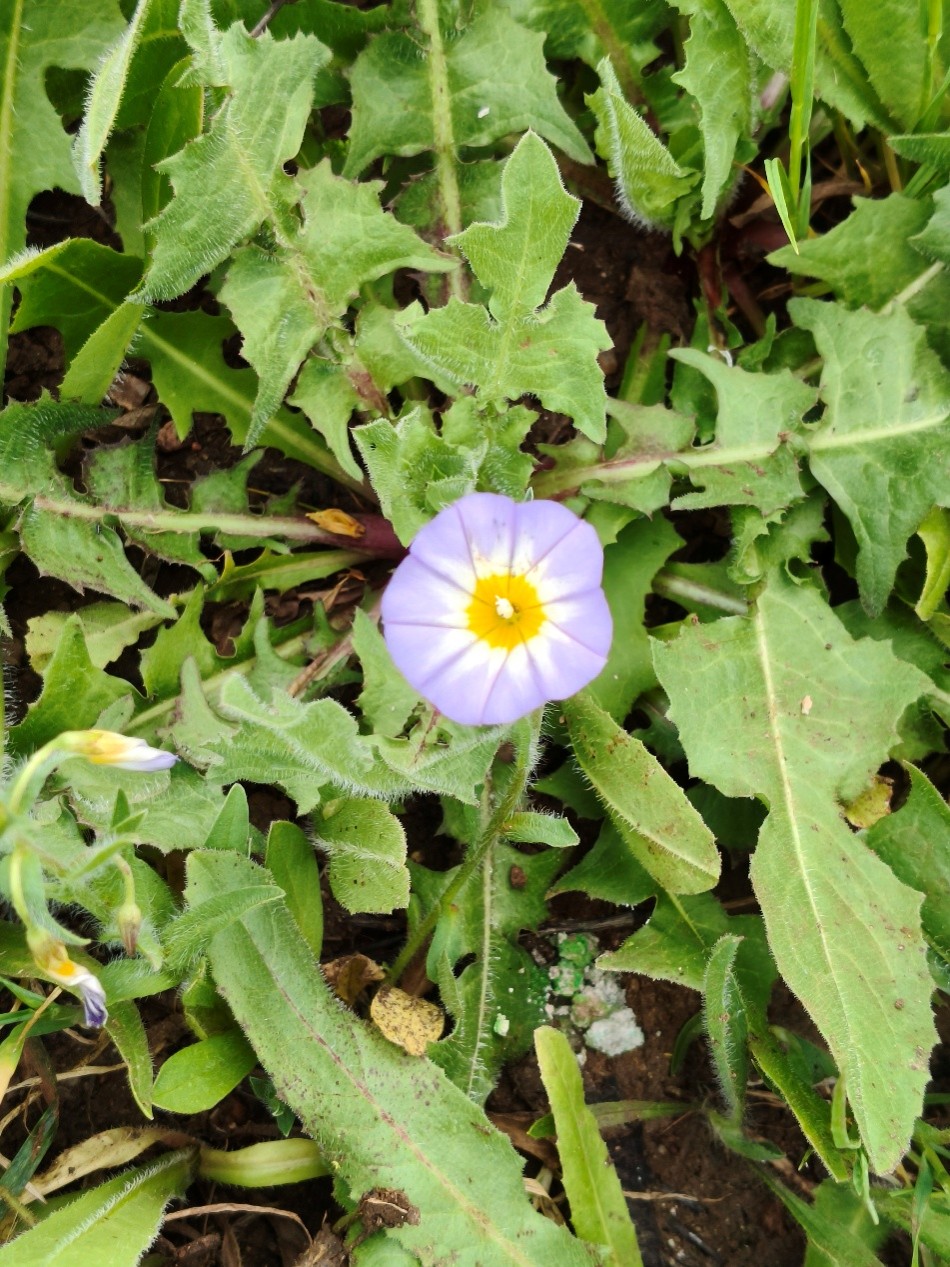
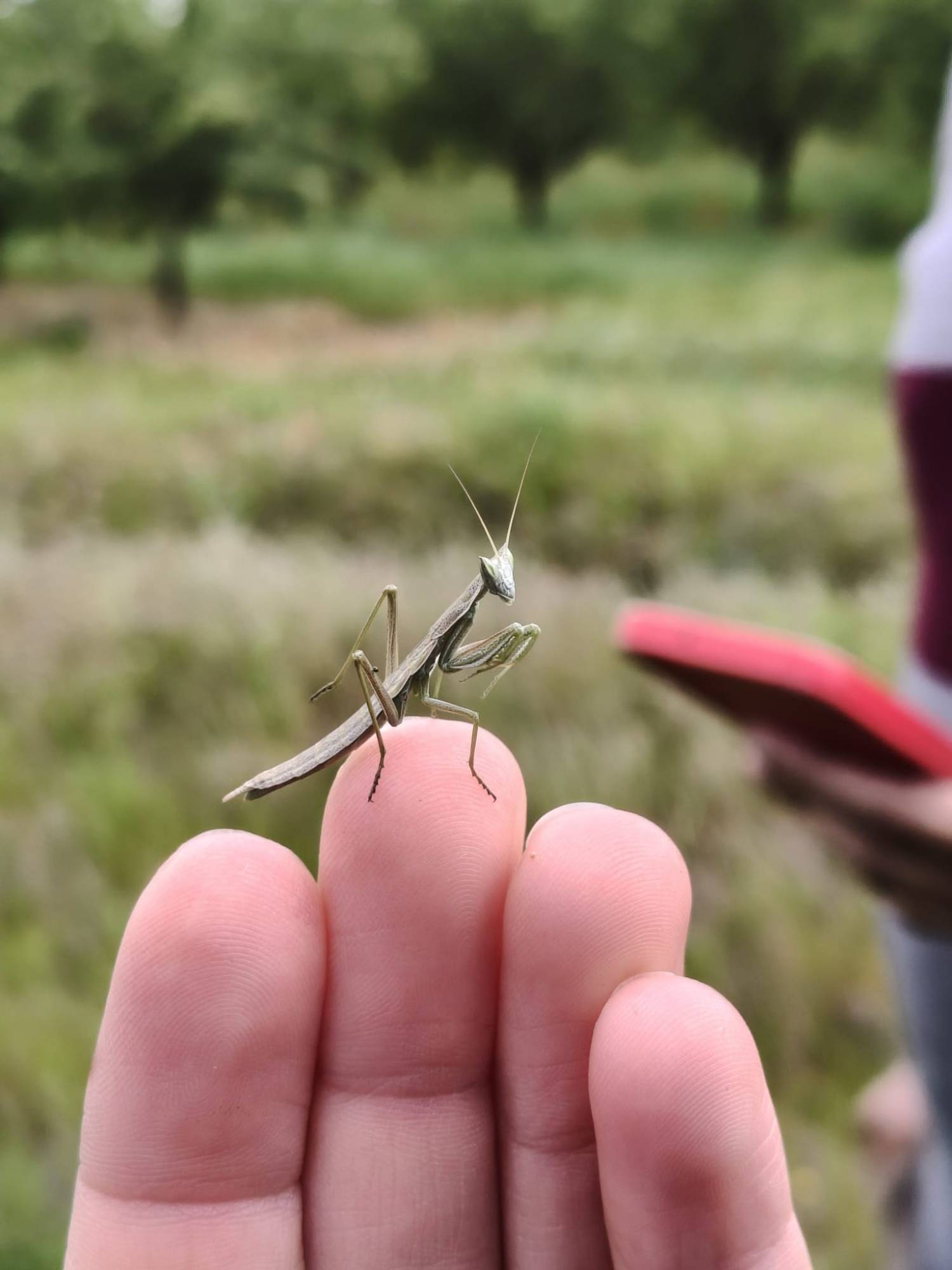
Flora · RELAPE species
| Species | Common name | Ecology | RELAPE typology |
|---|---|---|---|
| Carlina hispanica | — | Uncultivated land, scrublands and other ruderal habitats, especially dry, sunny and often degraded sites. | Ibero-Maghrebian endemic |
| Convolvulus meonanthus | — | Field margins, fallows, open oak woodlands, roadsides, ditches and grasslands, often on disturbed or clay-rich soils. | Rare |
| Dipsacus comosus | — | Fallow land, roadsides and other ruderal habitats, generally on somewhat moist, nitrogen-rich soils. | Iberian endemic |
| Phalaris aquatica | Harding grass | Cultivated and ruderal ground, stream banks and other moist or seasonally wet grasslands. | Rare |
| Plantago albicans | Hoary plantain | Dry, sunny perennial grasslands and subnitrophilous ruderal or roadside communities, often on calcareous or stony soils. | Rare |
| Quercus rotundifolia | Holm oak | Mediterranean evergreen forests and woodlands, including open dehesa or montado systems, on a wide range of generally dry soils. | Protected |
| Thapsia transtagana | — | Clearings and edges of Mediterranean scrub and woodland, grasslands, roadsides and other subruderal habitats. | Ibero-Maghrebian endemic |
| Tolpis barbata | European umbrella milkwort | Ruderal grasslands, scrublands, cultivated plots, roadsides and other disturbed sites. | Ibero-Maghrebian endemic |
Fauna · species of conservation interest
| Species | Common name | Group | Portugal Red List |
|---|---|---|---|
| Alcedo atthis | Common kingfisher | Birds | Least Concern (LC) |
| Burhinus oedicnemus | Eurasian stone-curlew | Birds | Vulnerable (VU) |
| Ciconia ciconia | White stork | Birds | Least Concern (LC) |
| Circaetus gallicus | Short-toed snake eagle | Birds | Near Threatened (NT) |
| Columba palumbus | Common wood pigeon | Birds | Least Concern (LC) |
| Galerida theklae | Thekla's lark | Birds | Least Concern (LC) |
| Hieraaetus pennatus | Booted eagle | Birds | Least Concern (LC) |
| Lanius meridionalis | Iberian grey shrike | Birds | Vulnerable (VU) |
| Lanius senator | Woodchat shrike | Birds | Vulnerable (VU) |
| Lullula arborea | Woodlark | Birds | Least Concern (LC) |
| Milvus migrans | Black kite | Birds | Least Concern (LC) |
| Streptopelia turtur | European turtle dove | Birds | Near Threatened (NT) |
| Lutra lutra | Eurasian otter | Mammals | Least Concern (LC) |
| Oryctolagus cuniculus | European rabbit | Mammals | Vulnerable (VU) |
| Apteromantis aptera | Iberian mantis | Insects (Mantodea) | Least Concern (LC) |
| Hemorrhois hippocrepis | Horseshoe whip snake | Reptiles | Least Concern (LC) |
| Podarcis virescens | Western Iberian wall lizard | Reptiles | Least Concern (LC) |
Agroecological value matrix
To understand the current overall agroecological status of Herdade de Meirinho and establish a baseline from which agroecological value can be measured, an Agroecological Value Matrix was used.
In its current state, the property has a combined value of 2.29 – corresponding to a medium agroecological value. This reflects reasonable soil cover in the orchard inter-rows and the presence of several Natura 2000 habitats, offset by the very small extent of semi-natural area and the absence of any High Natural Value Areas.
It is expected that management actions planned for the farm will result in significant improvements to the Agroecological Value Matrix over the medium term.
| Indicator | Level 1 | Level 2 | Level 3 | Level 4 | Current | Justification |
|---|---|---|---|---|---|---|
| 1. Functional biodiversity (only for production areas when these account for more than 50% of the property) | No functional biodiversity structures | Functional biodiversity structures in ≤ 30% of the area | Functional biodiversity structures in > 30% and < 50% of the area | Functional biodiversity structures in ≥ 50% of the area | 4 | In the production areas, cover crops (spontaneous vegetation) are installed in the HD almond orchard and soil cover accounts for more than 50% of the inter-row. |
| 2. Habitat of conservation interest | No habitat or only potential/vestigial habitats present | At least 1 habitat present | At least 2 habitats present | At least 2 habitats in good conservation status, and/or 1 habitat in good conservation status over ≥ 50% of the area | 3 | Three habitats present, but none in good conservation status. |
| 3. RELAPE flora species | RELAPE flora ≤ 5% | RELAPE flora 6–12% | RELAPE flora 13–20% | RELAPE flora > 20% | 2 | 7.8% of flora species are RELAPE. |
| 4. Habitat for wildlife of conservation interest | Area without feeding habitat or refuge, though occasional records may occur | Feeding habitat and refuge present, but without connectivity | Feeding habitat and refuge connected, but small or patchy with known hazards | Feeding habitat and natural refuge connected | 3 | Feeding habitat and refuge are present — for example for the Iberian mantis — but the areas are small and patchy. |
| 5. Land dedicated to biodiversity (non-productive, non-artificialised areas) | 0–25% of property | 25–50% | 50–75% | > 75% | 1 | 2.6% of the property corresponds to semi-natural areas. |
| 6. Areas of High Natural Value (HNVA) | 0–25% of non-productive areas are HNVA | 25–50% | 50–75% | > 75% | 1 | There are no HNVAs. |
| 7. Landscape mosaic | 0–1 of the 5 elements present | 2 of the 5 elements | 3 of the 5 elements | 4–5 of the 5 elements | 2 | Two of the five elements present (see habitats table). |
| Overall agroecological value | 2.29 | Medium agroecological value | ||||
Herdade de Montinho & Monte Migueis
Ourique, Alentejo
Ecologists from NBI also visited Herdade de Montinho and Monte Migueis to develop an understanding of the existing state of biodiversity and overall agroecological value on the properties. Their most important findings are summarised in this section.
Summary
| Category | Indicator | Value |
|---|---|---|
| Habitats & Landscape | Percentage of semi-natural area | 15% |
| Percentage of semi-natural area that corresponds to HNVA | 12.4% | |
| Number of Natura 2000 network habitats present | 12 | |
| Flora | Number of flora species | 150 |
| Percentage of flora species of conservation interest | 16.7% | |
| Fauna | Number of bird species | 54 |
| Number of mammal species | 7 | |
| Number of reptile species | 5 | |
| Number of amphibian species | 6 | |
| Percentage of fauna species of conservation interest | 23.4% |
All twelve habitats are present or vestigial (no potential habitats). Invertebrates (22 species) are not counted in the fauna rows above.
Habitats
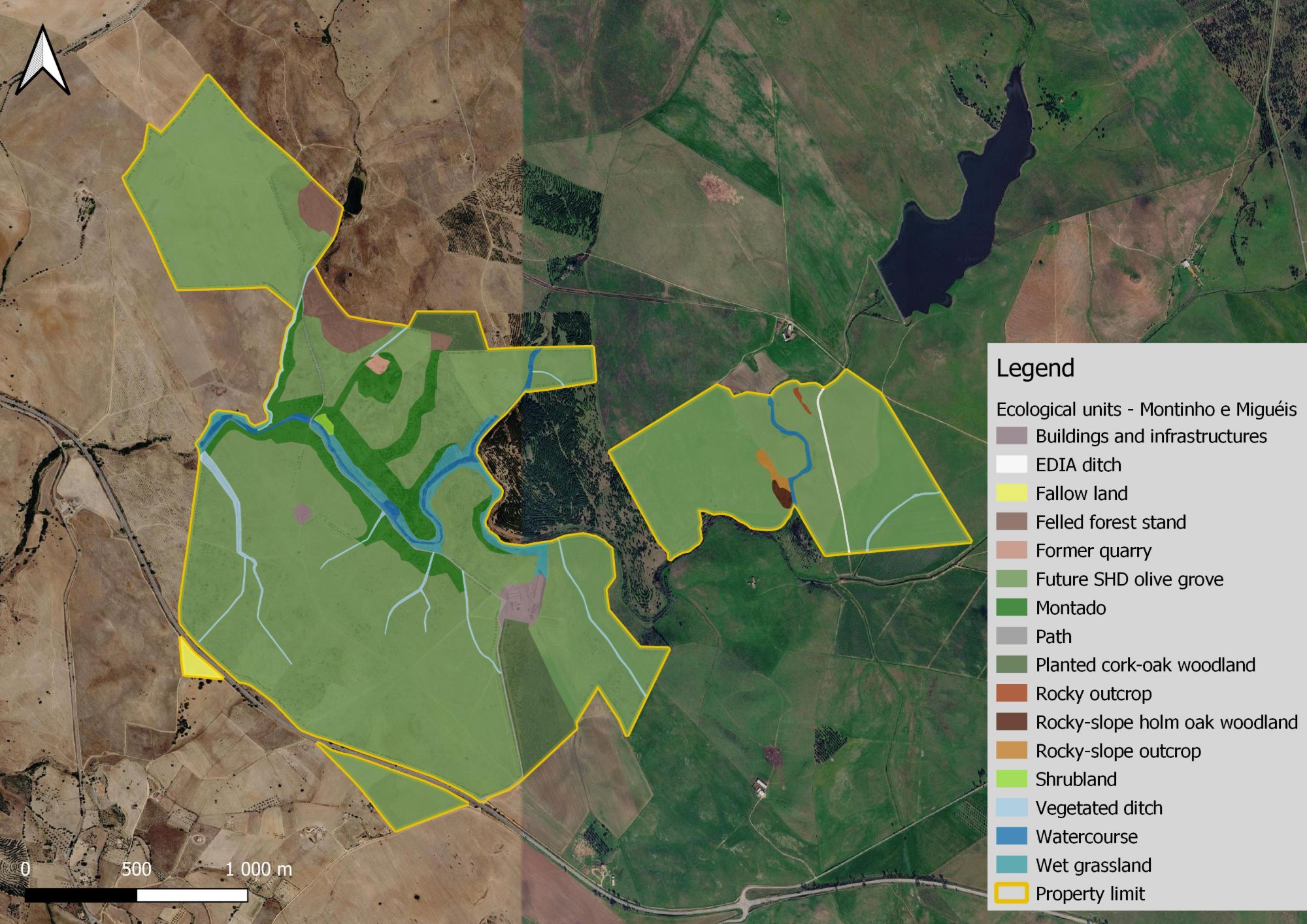
The habitats on the properties were assessed based on observations during a site visit in April 2026, knowledge of the region, and bibliographic analyses. Semi-natural areas currently make up around 15 percent of the property (approximately 68 of its 456 hectares), the remainder being largely given over to land under preparation for a super-high-density olive grove.
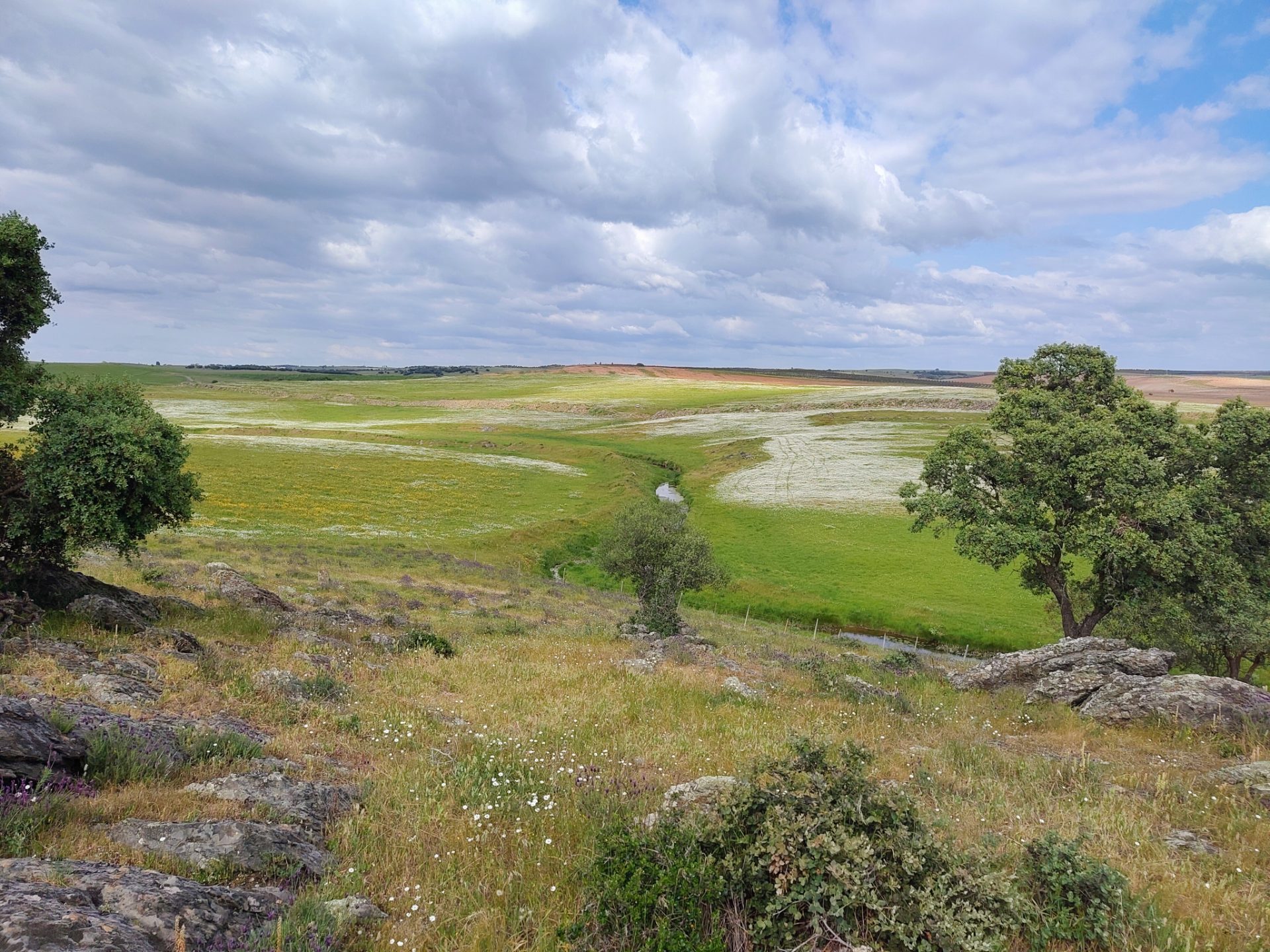
A total of twelve habitats were identified — nine present and three vestigial. Of particular interest is the area along the Ribeira da Ferraria, which bisects Herdade de Montinho and contains a number of natural habitats. One of the habitats present, the pseudo-steppe with grasses and annuals (6220*), is a priority habitat for conservation.
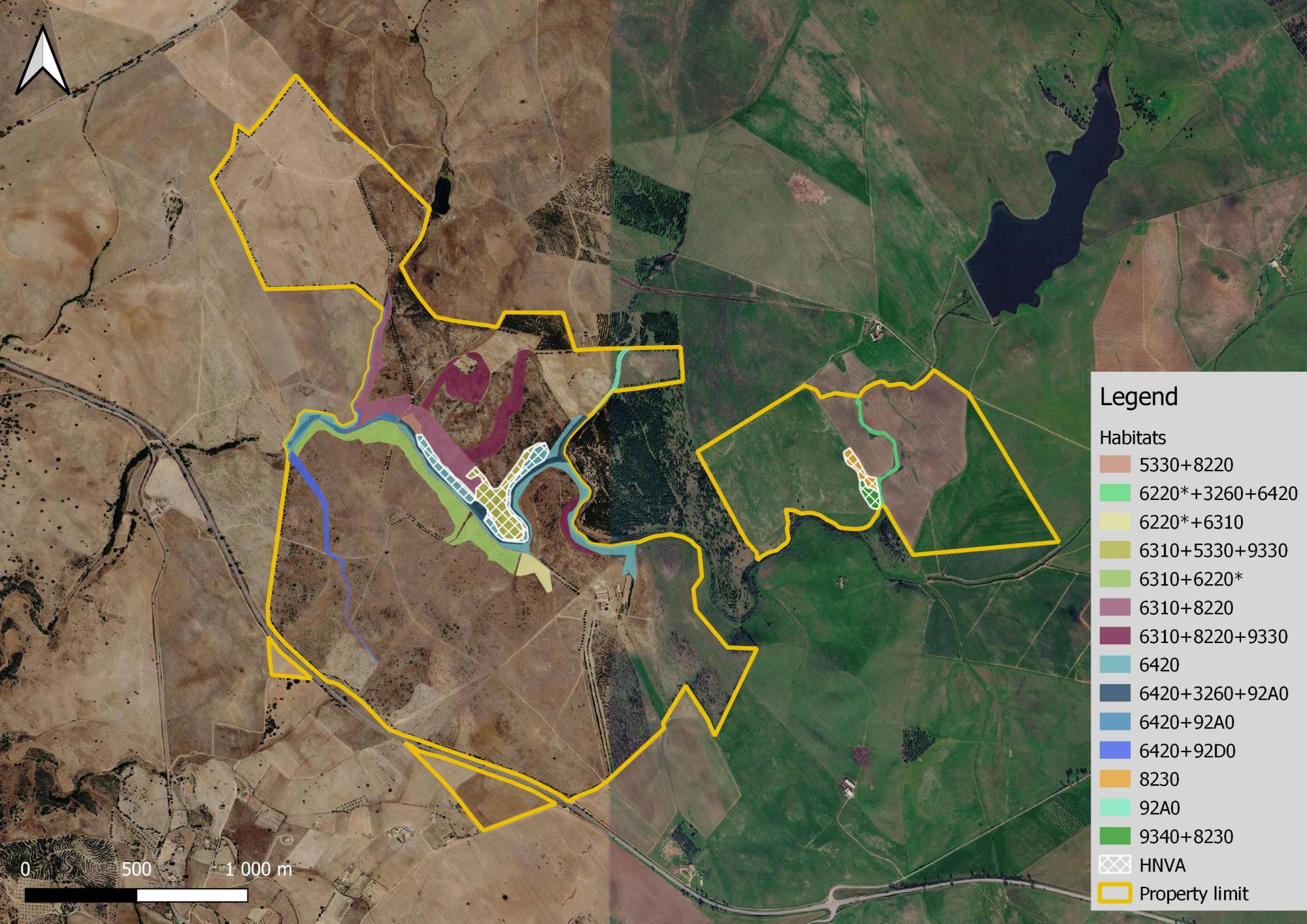
The map shows the distribution of the habitats on the properties, along with management actions for each.
The following table gives details of the types of habitat on the properties along with their classification according to the Natura 2000 protected areas network58
| Element | Habitat | Common name | RN2000 code | Relevance | Conservation status | Tendency 3–5 yrs · without measures | Tendency 3–5 yrs · with restoration & conservation | Management actions |
|---|---|---|---|---|---|---|---|---|
| Water | Temporary mediterranean water streams from Paspalo-Agrostidion | Temporary stream | 3290 | Present | Green | Stable to declining. Intensive agriculture, nutrient-rich runoff, channel modification and unchecked succession may reduce habitat quality or replace open herbaceous communities. | Stable to improving. Maintaining natural hydrology and low-intensity disturbance should preserve the habitat; limited succession towards riparian vegetation may occur naturally. | Maintain natural flow and channel morphology; prohibit channelisation and heavy mechanical clearance; reduce fertiliser and effluent inputs; retain buffer strips; use extensive grazing or targeted mowing where succession is excessive; control invasive plants. |
| Water courses of plain to montane levels with Ranunculion fluitantis and Callitricho-Batrachion vegetation | Water courses with floating aquatic vegetation | 3260 | Present | Amber | Declining. Water abstraction, sedimentation, eutrophication, drainage and hydraulic works may reduce characteristic aquatic vegetation and favour tolerant or emergent species. | Stable to improving. Better water quality, adequate seasonal flows and reduced physical disturbance should allow aquatic vegetation to recover. | Prevent untreated effluents and agrochemical runoff; maintain environmental flows; restrict abstraction, drainage and hydraulic works; establish vegetated buffers; avoid bed disturbance; monitor water quality, flow and characteristic aquatic plants. | |
| Water habitat | Salix alba and Populus alba galleries | Riparian woodland | 92A0 | Present | Green | Strongly declining, with risk of local habitat loss. Continued cutting, livestock access and bank disturbance would prevent regeneration, increase fragmentation and expose the channel to erosion. | Improving, although structural recovery will remain incomplete within 3–5 years. Protected coppice and natural regeneration, supported by planting, should re-establish a young riparian corridor. | Immediately prohibit further cutting and heavy machinery; protect surviving trees, stumps and natural regeneration; temporarily exclude livestock; restore the gallery with locally appropriate native Salix/Populus material; stabilise banks using bioengineering where needed; control invasives and monitor survival annually. |
| Meridional river intermittent galleries (Nerio-Tamaricetea e Securinegion tinctoriae) | “Barranco” | 92D0 | Vestigial | Red | Declining, with high risk of local disappearance. In vestigial ravine sections, continued channel cleaning, bank disturbance, grazing or trampling, altered runoff, nutrient inputs, water abstraction and invasive plants may prevent regeneration and reduce the habitat to isolated shrubs or herbaceous drainage lines. | Stable to improving, although recovery will remain slow and discontinuous within 3–5 years. Protection of the channel and margins, reduction of disturbance and reinforcement of locally appropriate native riparian shrubs should consolidate a young intermittent riparian corridor. | Map and protect the channel and both margins; establish a 5–10 m buffer where feasible; prohibit channelisation, infilling, heavy mechanical clearance, ploughing and pesticide or fertiliser drift; exclude or tightly manage livestock; retain existing native riparian shrubs and resprouts; reinforce with local-provenance riparian planting where natural regeneration is insufficient; control invasive plants; monitor bank stability, recruitment and plant survival annually. | |
| Mediterranean tall humid grasslands | Wet grassland | 6420 | Present | Green | Stable to declining. Drainage, conversion, nutrient enrichment, excessive grazing or abandonment followed by shrub encroachment may reduce characteristic rush and tall-herb communities. | Stable to improving. Hydrological protection and moderate seasonal management should maintain open humid grassland and characteristic species. | Prevent drainage and conversion to irrigated agriculture; exclude fertiliser and herbicide inputs; apply light seasonal grazing or late mowing; avoid grazing during waterlogged periods; selectively remove encroaching shrubs without disturbing the soil; monitor water-table conditions. | |
| Fire — Shrubland habitat | Thermo-Mediterranean and pre-desert scrub | Shrubland | 5330 | Vestigial | Amber | Declining, with risk of local habitat loss. Small vestigial scrub patches are vulnerable to clearing, mechanical fuel management, conversion to agriculture, grazing or browsing pressure, repeated fire, herbicide drift, invasive or exotic woody species and fragmentation; open remnants may be simplified into ruderal grassland or lost. | Stable to improving. Strict protection of remnant patches, selective mosaic fuel management and assisted natural regeneration should increase native shrub cover and structural diversity, although expansion will be slow and patchy within 3–5 years. | Treat remnant patches as conservation nuclei; prevent conversion, ploughing, soil mobilisation, dumping and herbicide or fertiliser drift; avoid blanket shrub clearance; apply selective fuel management in mosaic, retaining native shrub structure and open grassland edges; promote natural regeneration of characteristic shrubs; use local-provenance planting only where recruitment is absent; control invasive or exotic woody species; connect patches with hedgerows, woodland edges, rocky areas and riparian corridors; monitor every 1–2 years. |
| Earth | Pseudo-steppe with grasses and annuals | Perennial grassland | 6220* | Present | Green | Declining. Agricultural intensification, ploughing, fertilisation, overgrazing or abandonment with shrub encroachment may reduce floristic diversity and habitat extent. | Stable to improving. Appropriate extensive grazing and selective scrub control should retain open, species-rich grassland and promote characteristic annual communities. | Maintain light-to-moderate extensive grazing with seasonal rest; avoid ploughing, reseeding, fertilisers and herbicides; control shrubs and invasive plants by selective, soil-safe methods; exclude infrastructure and vehicle disturbance; monitor characteristic species and bare-ground balance. |
| Grassland habitat | Dehesas/Montados with evergreen Quercus spp. | Montado | 6310 | Present | Amber | Gradually declining. Ageing trees, weak regeneration, soil compaction, overgrazing, root-zone disturbance, drought and disease may progressively reduce tree density and ecological condition. | Stable to improving. Protection of regeneration and balanced grazing should strengthen age structure, ground cover and long-term resilience. | Protect mature trees and natural regeneration; install guards or temporary grazing exclusions; apply rotational grazing with recovery periods; avoid deep tillage and machinery beneath crowns; retain a mosaic of pasture, shrubs and habitat 6220 patches; monitor mortality, pests, disease and recruitment. |
| Wood — Woodland habitat | Quercus suber forests | Cork oak woodland | 9330 | Vestigial | Green | Declining, with high risk of local loss. Small, isolated patches are vulnerable to cutting, browsing, fire, edge effects and failure of regeneration. | Stable to slightly improving. Strict protection and assisted regeneration should increase recruitment and structural quality, although expansion will be slow within 3–5 years. | Treat patches as strict conservation zones; prohibit cutting and livestock access; protect natural regeneration and retain the native shrub mantle; use local-provenance planting only where recruitment is insufficient; remove invasive trees; reduce fire risk without clearing the woodland edge; improve connectivity between patches. |
| Quercus rotundifolia forests | Holm oak woodland | 9340 | Present | Green | Stable to declining. Cutting, grazing pressure, soil disturbance, fire and poor regeneration may simplify woodland structure and progressively convert closed woodland into degraded open formations. | Stable to improving. Protection from disturbance and assisted regeneration should increase recruitment, canopy continuity and woodland resilience. | Prevent cutting, land conversion and soil mobilisation; exclude or tightly control grazing in regeneration areas; protect seedlings and resprouts; plant local-provenance holm oak only where necessary; conserve shrub edges and deadwood; control invasive species; implement proportionate fire-prevention measures and monitor recruitment. | |
| Metal — Rocky habitat | Siliceous rocky slopes with chasmophytic vegetation | Siliceous rocky slopes | 8220 | Present | Green | Stable to slightly declining, mainly due to physical disturbance, rock removal, invasive species, fire or excessive shading. | Stable to slightly improving, through protection of rock faces and natural regeneration. | Delimit and protect occurrences; exclude earthworks, vehicles, dumping and rock removal; control invasive species; selectively reduce excessive shrub cover; monitor every 1–2 years. |
| Siliceous rock with pioneer vegetation of the Sedo-Scleranthion or Sedo albi-Veronicion dillenii | Siliceous rock with pioneer vegetation | 8230 | Present | Green | Stable to moderately declining, due to trampling, soil disturbance, agrochemical drift, nutrient enrichment and shrub encroachment. | Stable to improving, if open, nutrient-poor rocky areas are maintained and disturbance is reduced. | Exclude machinery and soil disturbance; prevent fertiliser and herbicide drift; manage livestock access; manually control shrub encroachment where necessary; monitor every 1–2 years. |
Flora and Fauna
In total, 150 species of flora were identified on Herdade de Montinho and Monte Migueis, of which 25 are classified as RELAPE (Rare, Endemic, Local, At risk, Protected or Endangered) – 16.7% of the total.
Ninety-four species of fauna were detected – 72 vertebrates (54 birds, 7 mammals, 5 reptiles and 6 amphibians) and 22 invertebrates – of which 22 are of conservation interest (23.4%).
Details of the RELAPE flora and of fauna of conservation interest are given in the tables below.
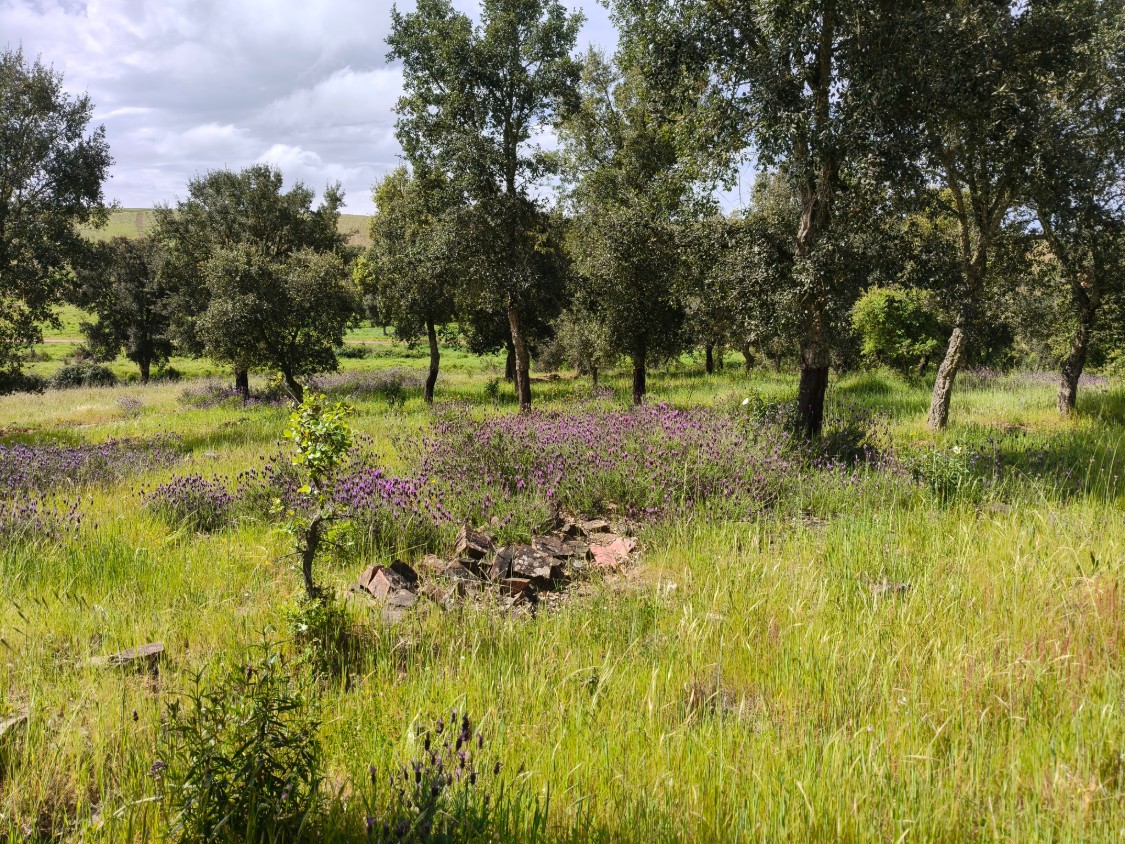
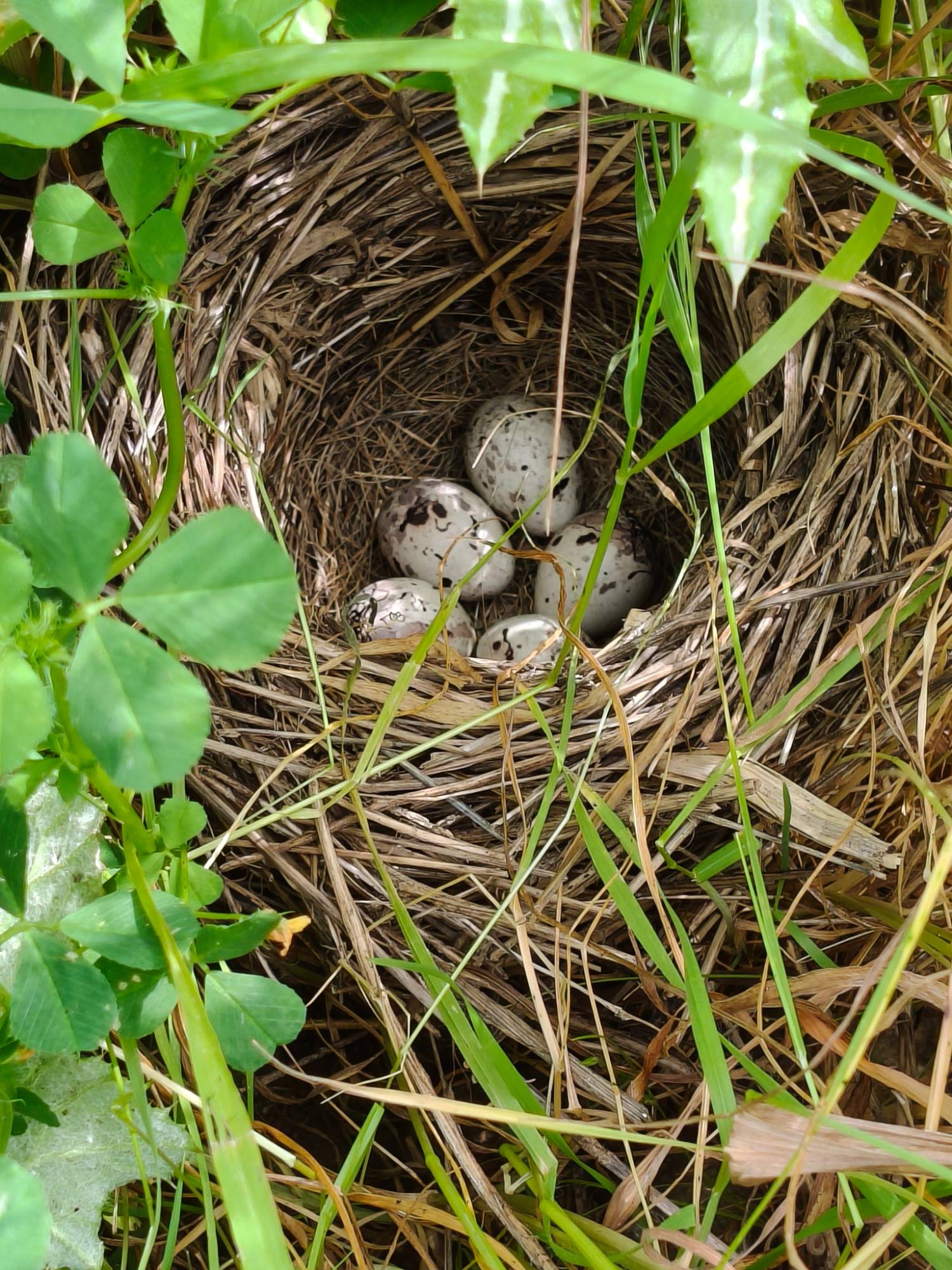
Flora · RELAPE species
| Species | Common name | RELAPE typology |
|---|---|---|
| Anacyclus clavatus | White anacyclus | Rare |
| Arisarum simorrhinum | Friar's cowl | Ibero-Maghrebian endemic |
| Aristolochia paucinervis | — | Ibero-Maghrebian endemic |
| Asphodelus serotinus | — | Iberian endemic |
| Cynara algarbiensis | — | Iberian endemic |
| Cynara humilis | Cardoon | Ibero-Maghrebian endemic |
| Cytisus grandiflorus | Giant-flowered broom | Ibero-Maghrebian endemic |
| Dianthus lusitanus | Portuguese pink | Ibero-Maghrebian endemic |
| Dipsacus comosus | — | Iberian endemic |
| Fumaria agraria | Field fumitory | Rare |
| Hymenocarpos lotoides | — | Ibero-Maghrebian endemic |
| Lavandula pedunculata | Butterfly lavender | Ibero-Maghrebian endemic |
| Linaria pseudamethystea | — | Iberian endemic |
| Margotia gummifera | Fetid margotia | Ibero-Maghrebian endemic |
| Pyrus bourgaeana | Iberian pear | Ibero-Maghrebian endemic |
| Quercus rotundifolia | Holm oak | Protected |
| Quercus suber | Cork oak | Protected |
| Rumex induratus | — | Ibero-Maghrebian endemic |
| Rumex palustris | Marsh dock | Rare |
| Salix neotricha | — | Rare |
| Sedum arenarium | Sand stonecrop | Iberian endemic |
| Spergularia purpurea | Purple sand-spurrey | Ibero-Maghrebian endemic |
| Stipa gigantea | Giant feather grass | Ibero-Maghrebian endemic |
| Thapsia transtagana | — | Ibero-Maghrebian endemic |
| Tolpis barbata | European umbrella milkwort | Ibero-Maghrebian endemic |
Fauna · species of conservation interest
| Species | Common name | Group | Portugal Red List |
|---|---|---|---|
| Epidalea calamita | Natterjack toad | Amphibians | Least Concern (LC) |
| Hyla meridionalis | Mediterranean tree frog | Amphibians | Least Concern (LC) |
| Alcedo atthis | Common kingfisher | Birds | Least Concern (LC) |
| Ardea ibis | Western cattle egret | Birds | Vulnerable (VU) |
| Ciconia ciconia | White stork | Birds | Least Concern (LC) |
| Circaetus gallicus | Short-toed snake eagle | Birds | Near Threatened (NT) |
| Clamator glandarius | Great spotted cuckoo | Birds | Near Threatened (NT) |
| Columba palumbus | Common wood pigeon | Birds | Least Concern (LC) |
| Curruca undata | Dartford warbler | Birds | Least Concern (LC) |
| Elanus caeruleus | Black-winged kite | Birds | Least Concern (LC) |
| Falco tinnunculus | Common kestrel | Birds | Vulnerable (VU) |
| Galerida theklae | Thekla's lark | Birds | Least Concern (LC) |
| Hieraaetus pennatus | Booted eagle | Birds | Least Concern (LC) |
| Lanius meridionalis | Iberian grey shrike | Birds | Vulnerable (VU) |
| Lanius senator | Woodchat shrike | Birds | Vulnerable (VU) |
| Lullula arborea | Woodlark | Birds | Least Concern (LC) |
| Milvus migrans | Black kite | Birds | Least Concern (LC) |
| Oenanthe hispanica | Western black-eared wheatear | Birds | Vulnerable (VU) |
| Lutra lutra | Eurasian otter | Mammals | Least Concern (LC) |
| Oryctolagus cuniculus | European rabbit | Mammals | Vulnerable (VU) |
| Hemorrhois hippocrepis | Horseshoe whip snake | Reptiles | Least Concern (LC) |
| Mauremys leprosa | Mediterranean pond turtle | Reptiles | Least Concern (LC) |
Agroecological value matrix
To understand the current overall agroecological status of Herdade de Montinho and Monte Migueis and establish a baseline from which agroecological value can be measured, an Agroecological Value Matrix was used.
In their current state, the properties have a combined value of 2.43 – corresponding to a medium agroecological value. This reflects the presence of all five landscape elements, twelve Natura 2000 habitats and a relatively high proportion of RELAPE flora, offset by the very small share of the property currently dedicated to biodiversity while the super-high-density olive grove is established, and by the limited connectivity between semi-natural patches.
A farm-level management plan is under development. It will include measures to preserve existing biodiversity and to improve it through careful management of existing habitats and the creation of new habitats where possible. It is expected that this will result in significant improvements to the Agroecological Value Matrix over the medium term.
| Indicator | Level 1 | Level 2 | Level 3 | Level 4 | Current | Justification |
|---|---|---|---|---|---|---|
| 1. Functional biodiversity (only for production areas when these account for more than 50% of the property) | No functional biodiversity structures | Functional biodiversity structures in ≤ 30% of the area | Functional biodiversity structures in > 30% and < 50% of the area | Functional biodiversity structures in ≥ 50% of the area | 1 | No cover crops installed yet: the areas where the super-high-density olive groves will be planted are under preparation and account for the majority of the property. |
| 2. Habitat of conservation interest | No habitat or only potential/vestigial habitats present | At least 1 habitat present | At least 2 habitats present | At least 2 habitats in good conservation status, and/or 1 habitat in good conservation status over ≥ 50% of the area | 4 | Eight habitats present in good conservation status. |
| 3. RELAPE flora species | RELAPE flora ≤ 5% | RELAPE flora 6–12% | RELAPE flora 13–20% | RELAPE flora > 20% | 3 | 16.7% of flora species are RELAPE. |
| 4. Habitat for wildlife of conservation interest | Area without feeding habitat or refuge, though occasional records may occur | Feeding habitat and refuge present, but without connectivity | Feeding habitat and refuge connected, but small or patchy with known hazards | Feeding habitat and natural refuge connected | 3 | Feeding habitat and refuge for species of conservation interest are present, but the semi-natural areas are surrounded by future olive groves and lack proper connection between patches. Introducing hedgerows in the production areas and restoring production/extraction areas such as felled forest stands could improve connectivity and enlarge the semi-natural areas. |
| 5. Land dedicated to biodiversity (non-productive, non-artificialised areas) | 0–25% of property | 25–50% | 50–75% | > 75% | 1 | 15% of the property corresponds to semi-natural areas — areas not dedicated to production or artificialised. |
| 6. Areas of High Natural Value (HNVA) | 0–25% of non-productive areas are HNVA | 25–50% | 50–75% | > 75% | 1 | 12.4% of non-productive areas are HNVA, with considerable potential for improvement, chiefly through restoring riparian galleries and montado. |
| 7. Landscape mosaic | 0–1 of the 5 elements present | 2 of the 5 elements | 3 of the 5 elements | 4–5 of the 5 elements | 4 | All five elements are present (see habitats table). |
| Overall agroecological value | 2.43 | Medium agroecological value. | ||||
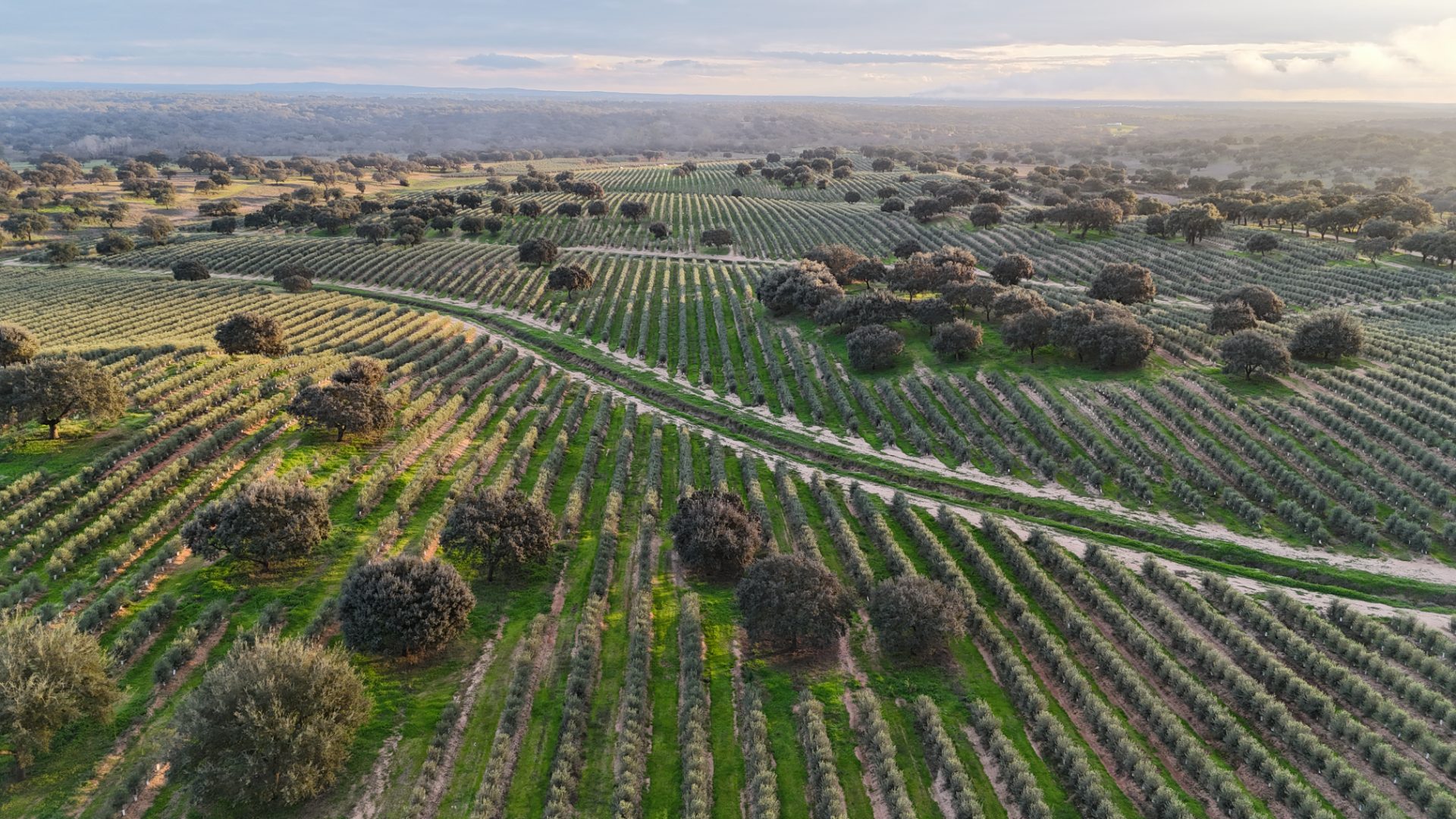
Fund-Level Agroeconomic Strategy & Farm-Level Management Plans
Fund-Level Agroeconomic Strategy
To ensure we maximise the resilience and impact benefits from regenerative agriculture, we have developed a fund-level strategy for Pela Terra II, supported by farm-level management plans.
The strategy sets out on the fund level the overall approaches that will ensure companies owned by the fund contribute to creating positive impact in each of the six thematic areas identified.
In order to ensure the strategy is informed by, and directionally consistent with, the main international sustainability frameworks, and to ensure a successful transition to regenerative systems, it is based around the following principles, drawing in particular on the Science Based Targets Network’s action framework and mitigation hierarchy and on the direction set by the Taskforce on Nature-related Financial Disclosures (TNFD), both of which the fund uses as methodological references:
Avoid → Minimise → Restore / Regenerate
- —Regeneration is a life-enhancing process, rather than a permanent state
- —Regeneration is outcome-oriented regarding social, ecological and economic health
- —Regeneration is context-specific
- —Regeneration is systemic
- —Land/water use change
- —Natural resources use / exploitation
- —Climate change
- —Pollution
- —Invasive alien species
Applying the mitigation hierarchy as a transversal approach
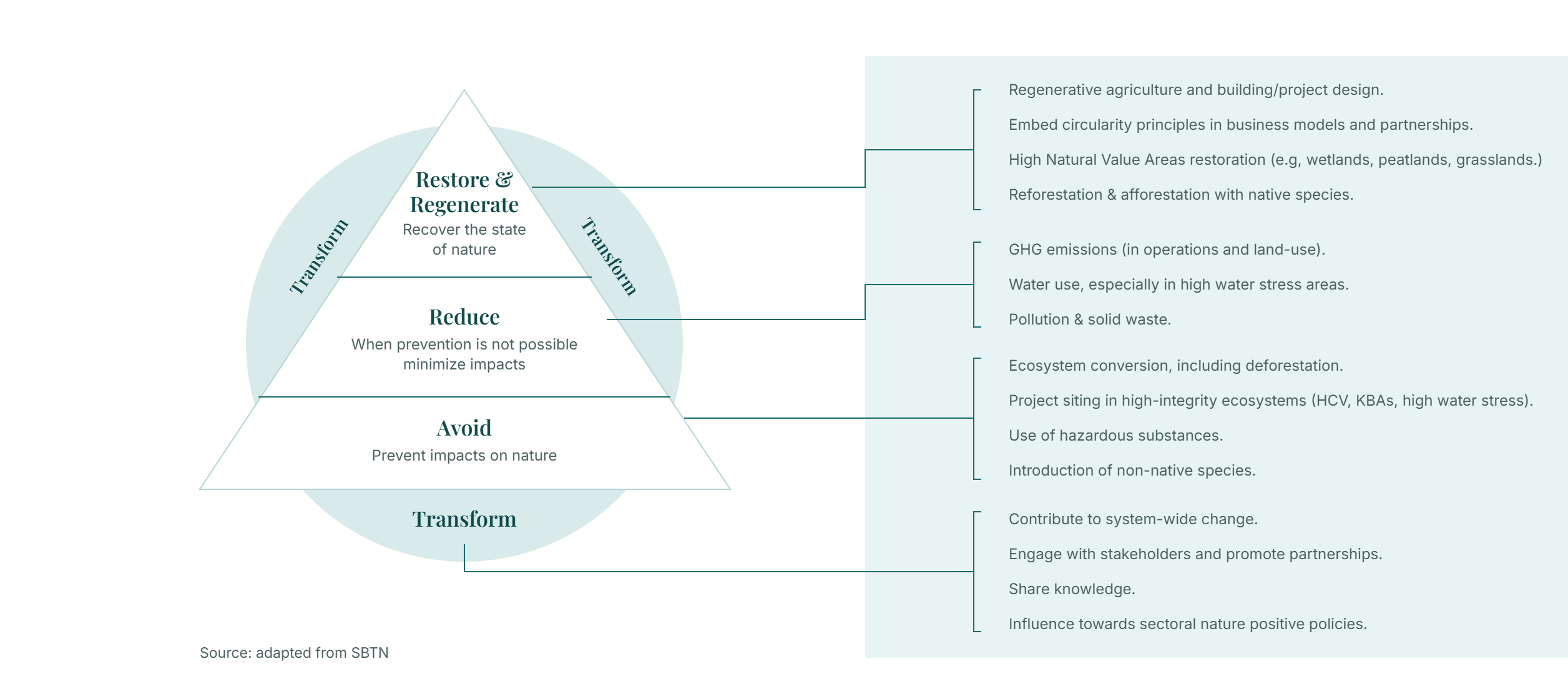
Based on the principles above, we have developed an overall agricultural and land management strategy which is specifically adapted to the context of intensive tree crop systems in Portugal. This strategy guides our management of all the assets in our portfolio, and is based around the following key elements:
01 · Follow the 5 soil health principles
Soil is capable of regenerating when the following principles are applied:
- —Maximise soil cover.
- —Minimise soil disturbance.
- —Integrate plant diversity.
- —Maximise live plant roots.
- —Where feasible, integrate livestock.
02 · Ensure efficient and responsible input use
Inputs are essential in intensive systems but come with economic and ecological challenges. Optimise their use through precision agriculture, comprehensive soil and plant analyses, and economic thresholds for interventions while exploring alternatives to reduce dependency on synthetic inputs.
03 · Manage tree health through nutrition
Proper tree nutrition is a cornerstone of ecosystem health. Proper nutrition is achieved through a sound fertilisation programme and, most importantly, a healthy, microbiologically active soil.
04 · Enhance functional biodiversity
Functional biodiversity supports functions such as pest control and pollination. Encouraging beneficial species aligns with a holistic approach to system health and resilience.
05 · Adaptive management
Tailor practices to the farm's unique and evolving conditions, including soil health, climate, and operational capacity. By monitoring outcomes and adjusting methods as needed, adaptive management minimises risks and maximises the success of regenerative practices. This approach enables continuous learning and improvement.
06 · The whole is greater than its parts
A regenerative agriculture approach relies on the interconnection of the system where practices work synergistically. The effectiveness of the system comes from synergy, not from treating practices as isolated options.
Farm-Level Management Plans
For each farm in the fund's portfolio, a tailored five-year transition plan has been developed, working with our farm operators and consultants where needed. Each plan is anchored in the fund-level strategy and based on a thorough diagnostic of the farm itself and historical management practices. Each plan focusses on managing the orchards for maximum yield and maximum impact in line with regenerative best practices.
However, in line with the strategy, each plan also looks at the farm as a whole, in the context of the landscape it is situated in, and aims at improving and maintaining the non-orchard areas to maximise functional biodiversity and ecosystem services provided.
The plans involve the use of a phased strategy to minimise transition risks while maximising opportunities for on-farm learning and adaptation.
We believe that they have the potential to significantly improve orchard performance while contributing to our impact goals in the short, medium and long term through regenerating the soil and the ecosystem as a whole.
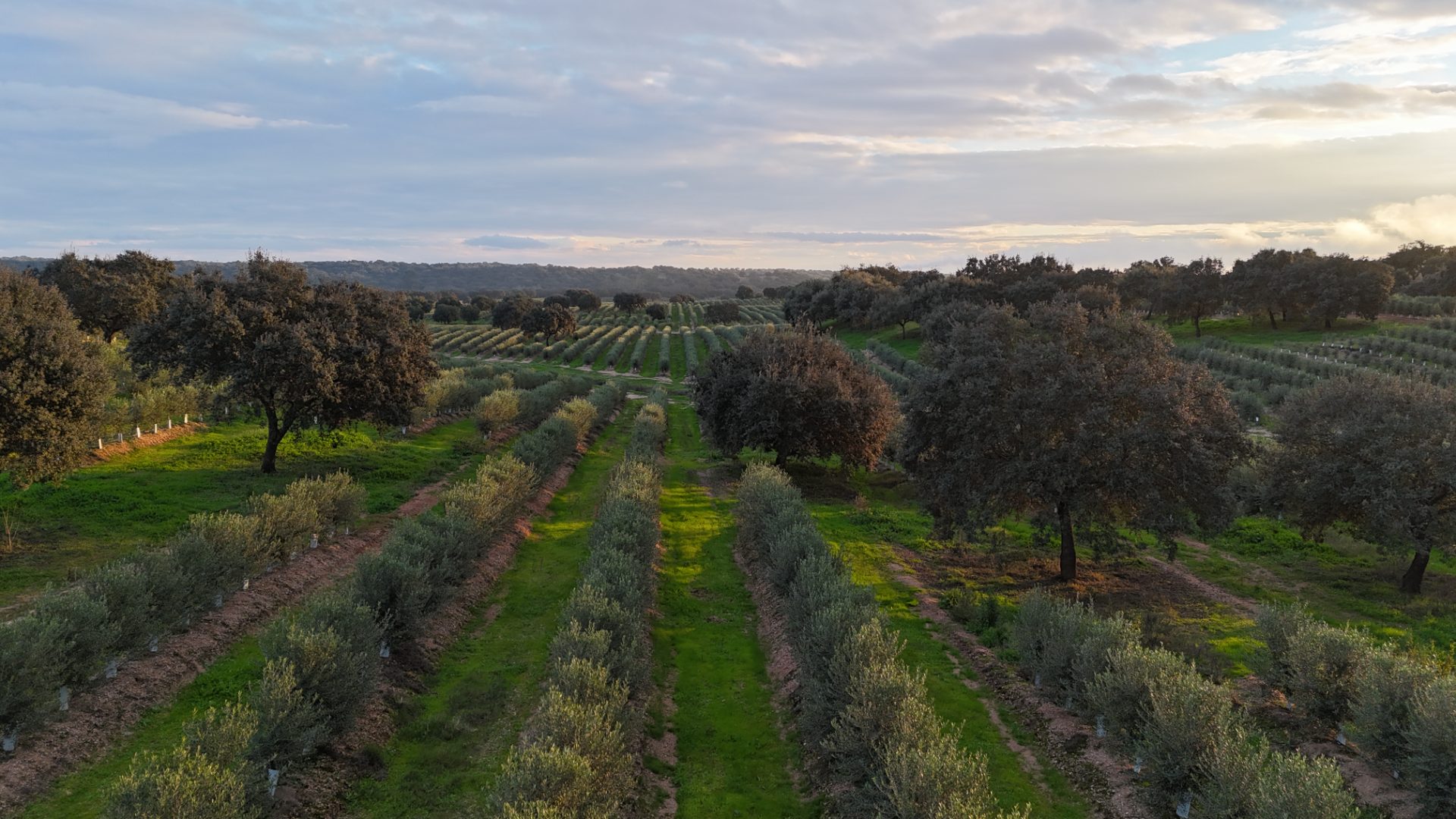
Our KPIs in Detail
2025 KPI Table
Performance against each 2030 KPI, shown per estate. Where a 2024 baseline exists, change is noted; many indicators were first measured in 2025 and will be tracked annually from this baseline.
| Impact theme | UN SDG targets | KPI | Sub-indicators | Baseline year | Herdade de Pombal | Palmeira | Meirinho | Montinho | Monte Migueis | Change vs 2024 | RAG |
|---|---|---|---|---|---|---|---|---|---|---|---|
| Soil | 2.4, 15.3 | Achieve an average 20% improvement in soil health indicators on all assets | 1.1. Soil Organic Carbon (%) | 2024-5 | 1.244 | 0.702 | 0.806 | 1.576 | 0.992 | Herdade de Pombal +266%; Palmeira +106% although sample sites differ from baseline | |
| 2.4, 15.3 | 1.2. Soil Aggregate Stability (AgroEco score 1-5) | 2025 | 1.5 | 3 | 3 | 1.7 | 1 | n/a (no 2024 baseline) | |||
| 2.4, 15.3 | 1.3. Soil Microbial Biomass (ug C/g) | 2025 | 238 | 45 | 242 | 415 | 543 | n/a (no 2024 baseline) | |||
| 2.4, 15.3 | 1.4. Soil Cation Exchange Capacity (meq) | 2025 | 25.9 | 23.6 | 14.1 | 11.9 | 7.7 | n/a (no 2024 baseline) | |||
| Water | 6.4 | Achieve a 10% decrease in water wastage through more efficient irrigation | 2.1. Operator assessment of water wastage | 2024-5 | New system being installed in 2026 | 0.1 | 2025 baseline year | 2025 baseline year | 2025 baseline year | n/a | |
| Climate | 13.2 | Reduce synthetic fertiliser inputs by 30% on a per-hectare basis | 3.1. Synthetic fertiliser applied per hectare (kg N) | 2024-5 | 70.6 | 153.2 | 106 | No baseline established | No baseline established | Herdade de Pombal -37%; Palmeira +55%; Meirinho acquired 2025. An action plan is in place to support reductions across all farms. | |
| Climate | 7.2, 13.2 | Achieve net negative greenhouse gas emissions on a per hectare level | 4.1. Production of 100% of energy needs using renewable sources | 2025 | 0 | 0 | 0 | 0 | 0 | n/a | |
| 13.2 | 4.2. Reduce Scope 1, 2 and 3 GHG emissions by 30% per ha | 2025 | No baseline established | No baseline established | No baseline established | No baseline established | No baseline established | n/a | |||
| 13.2 | 4.3. Sequester 10 tonnes of CO2 per managed hectare | 2024 | Not yet measured | 9.48 | 6.18 | Not yet measured | Not yet measured | n/a: these are cumulative totals | |||
| Biodiversity | 15.5 | Reduce herbicide use by 30% | 5.1. Herbicide applied per hectare (kg of active ingredient) | 2024 | 1.423 | 0.486 | 1.328 | 0 | 0 | Herdade de Pombal -89%; Palmeira -96% | |
| Biodiversity | 15.5 | Reduce pesticide use by 20% | 6.1. Pesticide applied per hectare (kg of active ingredient) | 2024 | 1.493 | 1.836 | 2.416 | No baseline established | No baseline established | Palmeira -87%; Herdade de Pombal up off low baseline | |
| Biodiversity | 15.5, 15.a | Achieve net positive biodiversity for all assets | 7.1. Detailed habitat assessments by NBI or equivalent external provider | 2025-6 | 1.57 | 1.57 | 2.29 | 2.43 | 2.43 | Meirinho, Montinho and Monte Migueis measured in 2026 | |
| 15.5 | 7.2. Grassland butterfly index | 2026 | Not yet measured | Not yet measured | Not yet measured | Not yet measured | Not yet measured | n/a | |||
| 15.5 | 7.3. Farmland bird index | 2026 | Not yet measured | Not yet measured | Not yet measured | Not yet measured | Not yet measured | n/a | |||
| Biodiversity | 15.5, 15.a | Set aside at least 5% of total managed land, managed primarily for biodiversity | 8.1. Land managed primarily for biodiversity / total land managed | n/a | 0% | 0% | 2.6% | 15% | 15% | Fund-level 8.6% | |
| Human Health | 2.1 | Achieve a 10% increase in nutrient density levels of all produce at harvest | 9.1. Minerals and metals | 2026 | Not yet measured | Not yet measured | Not yet measured | Not yet measured | Not yet measured | Not measured for 2025 harvest | |
| 2.1 | 9.2. Fatty Acid Profile Determination | 2026 | Not yet measured | Not yet measured | Not yet measured | Not yet measured | Not yet measured | Not measured for 2025 harvest | |||
| 2.1 | 9.3. Polyphenols | 2026 | Not yet measured | Not yet measured | Not yet measured | Not yet measured | Not yet measured | Not measured for 2025 harvest | |||
| 2.1 | 9.4. Vitamins | 2026 | Not yet measured | Not yet measured | Not yet measured | Not yet measured | Not yet measured | Not measured for 2025 harvest | |||
| Human Health | 3.9 | Reduce pesticide residues on all produce at harvest to under 50% of EU MRLs | 10.1. Insecticides | 2026 | Not yet measured | Not yet measured | Not yet measured | Not yet measured | Not yet measured | Not measured for 2025 harvest | |
| 3.9 | 10.2. Fungicides | 2026 | Not yet measured | Not yet measured | Not yet measured | Not yet measured | Not yet measured | Not measured for 2025 harvest | |||
| 3.9 | 10.3. Herbicides | 2026 | Not yet measured | Not yet measured | Not yet measured | Not yet measured | Not yet measured | Not measured for 2025 harvest | |||
| Society | 8.8 | Make 100% of capital investments in rural areas of Portugal | 11.1. Capital invested in rural Portugal / total capital | n/a | 1 | No change | |||||
| Society | 8.8 | Create 6 good jobs in rural areas of Portugal | 12.1. Total FTE jobs created directly as a result of Pela Terra II investments | n/a | 4.42 | 0 | 0 | 0 | n/a | ||
Estates: Herdade de Pombal, Palmeira, Meirinho, Montinho, Monte Migueis. Source: Pela Terra II 2025 impact data.
Interpreting these results
2025 was the first year in which all farms were sampled through the partnership with Terra Madre. Soil samples therefore differ in location and methodology from the 2024 baseline samples used for Herdade de Pombal and Palmeira, but sampling will be consistent from this point forward. On water, Herdade de Pombal will receive an entirely new irrigation system as part of its replanting project, and Palmeira has had significant efficiency-related upgrades for the same reason; on that basis the water-efficiency KPI is assessed as substantially met on those farms.
The movements in fertiliser inputs at Herdade de Pombal and Palmeira are driven by the replanting of Herdade de Pombal and a change of operator across both farms, rather than a mature orchard in regenerative transition; an action plan is in place to support reductions across all farms. The fund has not yet contracted a supplier for a full GHG audit. This is in the pipeline, though its timing is uncertain. Where farms are fully enrolled in the Terra Madre Terra+ carbon credit scheme, the fund already holds robust data on carbon sequestered, supporting the assessment that KPI 4.3 is on track to be achieved across the fund. Herbicide use has fallen on the farms that were in the portfolio last year, largely due to the change of operator, and the same is true of pesticides. On human health, the protocol for measuring nutrient density and pesticide residues was still in development in 2025.
Main risks and uncertainties
The principal risks to the 2030 targets are climatic and financial. Extreme weather could damage orchards and set back impact delivery, while prolonged drought could slow the regenerative transition; regenerative practices, including Whole Orchard Recycling, may deliver soil improvement more slowly than planned, and synthetic pesticide use may persist for longer than the impact strategy anticipates. Planned biodiversity enhancements depend on capital expenditure being approved and funded on schedule, and a shortfall in greenhouse-gas measurement or carbon programme delivery would undermine the fund’s climate claims. These risks are set out in the fund’s social and environmental performance risk assessment and reviewed annually, with mitigations tracked quarterly.
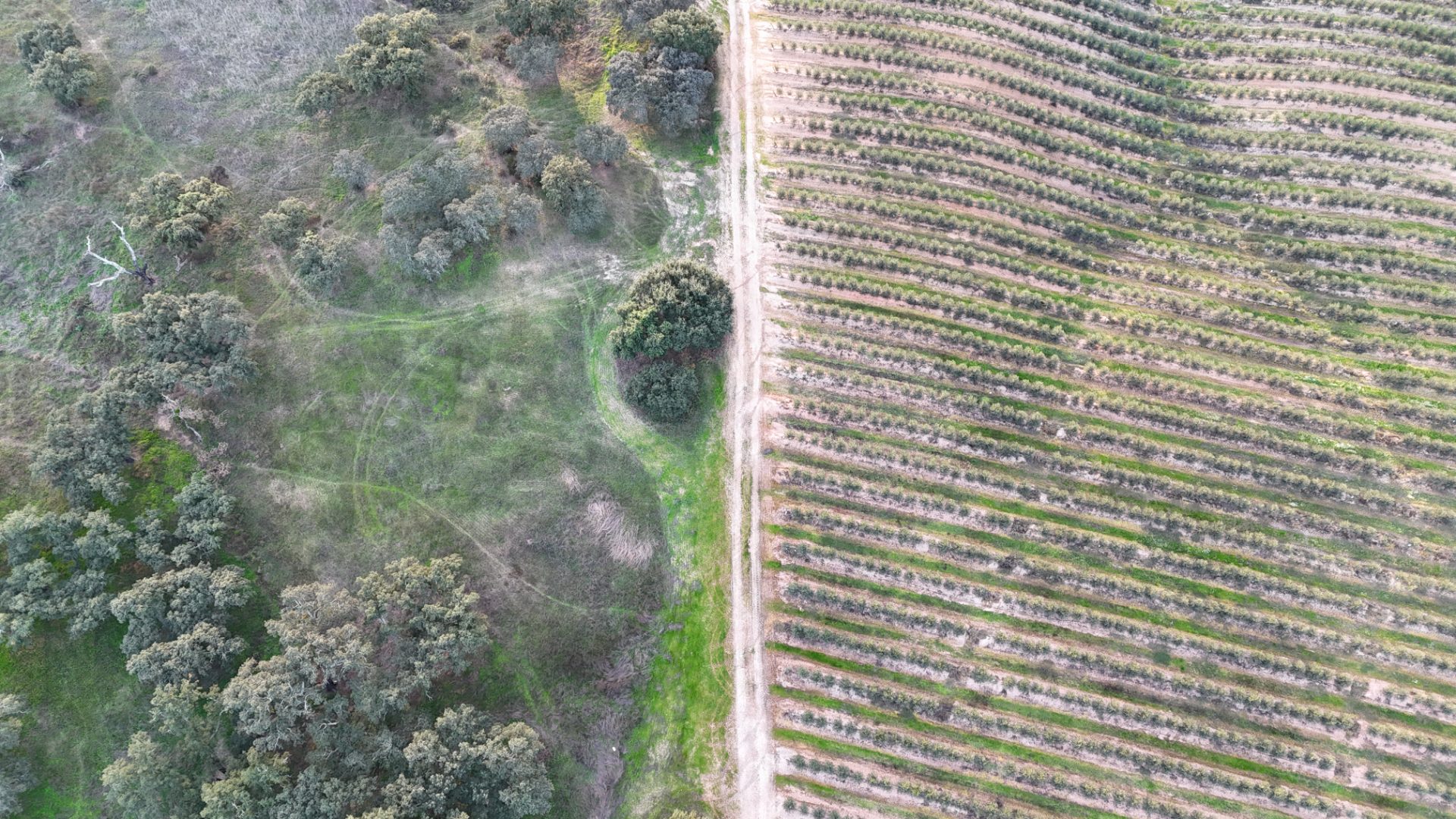
Impact Indicators
2025 Impact Indicators
The full set of impact indicators tracked across all five farms.
| Impact theme | UN SDG targets | IRIS+ ref | Indicator | Herdade de Pombal | Palmeira | Meirinho | Montinho | Monte Migueis | Comments |
|---|---|---|---|---|---|---|---|---|---|
| Cross-category and overall metrics | - | ID9608 | Total capital raised | €49.3M | |||||
| - | OD4108 | Environmental Impact objectives | Environmental Impact Objectives according to IRIS+ are: Agriculture — Sustainable Agriculture (Mitigating Climate Change through Sustainable Agriculture); Biodiversity and ecosystems (Improving Biodiversity through Nature-Based Solutions and Green Infrastructure; Improving Biodiversity through Terrestrial Ecosystem Protection and Restoration); Climate — Climate Change Mitigation (Mitigating Carbon Emissions from Forestry and Land Use; Mitigating Climate Change through Carbon Capture and Sequestration; Mitigating Climate Change through Clean Electricity and Heat Production); Water — Sustainable Water Management (Improving Agricultural Water Use Practices). | ||||||
| - | OD6247 | Social Impact objectives | Social Impact Objectives according to IRIS+ are: Employment - Other - Creation of jobs in rural / disadvantaged areas; Health - Nutrition. | ||||||
| - | OD4091 | Social and environmental targets | Yes, across 6 themes: soil, water, climate, biodiversity, health and society | ||||||
| - | OI4732 | Social and environmental performance reporting | Yes - public reports at least annually | ||||||
| - | OI9106 | Social and Environmental Performance Risk Assessment | Yes | Yes - plan and risk register reviewed and updated on a quarterly basis. | |||||
| - | OI5408 | Land directly controlled: total (ha) | 215 | 70 | 70 | 372 | 81 | ||
| - | OI1674 | Land directly controlled: cultivated (ha) | 200 | 69 | 70 | 0 | 0 | Montinho & Monte Migueis not yet planted. | |
| - | OI6912 | Land directly controlled: sustainably managed (ha) | 0 | 0 | 0 | 68.5 ha | 0 | Areas are land set aside for biodiversity only. | |
| - | OI2569 | Land directly controlled: treated with pesticides (ha) | 200 | 69 | 70 | 0 | 0 | All orchard areas are treated with pesticides | |
| - | PD1620 | Crop type | Olive | Olive | Almond | [unplanted] | [unplanted] | ||
| - | OI1120 | Operational certifications | 1 | 1 | 2 | 0 | 0 | Integrated production; Meirinho also has efficient water use certification | |
| - | PD2756 | Product / service certifications | 0 | 0 | 0 | 0 | 0 | ||
| Theme 1: Soil | 2.4, 15.3 | Level of Soil Organic Matter (%) | 2.145 | 1.21 | 1.39 | 2.717 | 1.714 | ||
| 2.4, 15.3 | Soil Organic Carbon (%) | 1.244 | 0.702 | 0.806 | 1.576 | 0.992 | SOC = SOM / 1.724. | ||
| 2.4, 15.3 | Soil pH (H2O) | 7.97 | 6.9 | 7.43 | 6.03 | 5.71 | |||
| 2.4, 15.3 | Soil Microbiology (microbial biomass, ug C/g) | 238 | 45 | 242 | 415 | 543 | Microbiometer; F/B ratio also available per parcel. | ||
| 2.4, 15.3 | Physical properties (bulk density, g/cm3) | 1.72 | 1.42 | 1.51 | 1.35 | 1.53 | |||
| 2.4, 15.3 | OI6381 | Soil conservation practices (type and ha) | Cover crops, naturally occurring, 200 ha | Cover crops, naturally occurring, 69 ha | Cover crops, seeded, 70 ha | n/a | n/a | Cover crops present on Herdade de Pombal, Palmeira, Meirinho. | |
| 2.4, 15.3 | OI1047 | Soil health practices (type and ha) | Cover crops, naturally occurring, 200 ha | Cover crops, naturally occurring, 69 ha | Cover crops, seeded, 70 ha | n/a | n/a | ||
| Theme 2: Water | 6.4 | Total water use by tonne of yield (m3/t) | 277 | 285 | 5323 | 0 | 0 | ||
| 6.4 | Implementation of water-saving technologies (type, area) | Drip irrigation; automatic control | Drip irrigation; automatic control | Drip irrigation; automatic control | None yet | None yet | Irrigation systems on Montinho and Monte Migueis will be installed in 2026 | ||
| 6.4 | OI9326 | Water conservation strategy | Yes | Yes | Yes | Yes | Yes | Yes - reviewed regularly and updated as needed | |
| 6.4 | OI2799 | Level of water stress | High | High | High | High | High | Source: WRI Aqueduct. | |
| 6.4 | OD7536 | Water type | Irrigation system | Irrigation system | Irrigation system | Irrigation system | Irrigation system | ||
| 6.4, 15.5 | Actions to improve farm waterlines and ditches | None in 2025 | None in 2025 | None in 2025 | None yet | None yet | |||
| Theme 3: Climate | 13.2 | PI4127 | Area of trees planted: total (ha) | 0 | 0 | 0 | 0 | 0 | Montinho and Monte Migueis will be planted starting 2026 |
| 13.2, 15.5 | PI3848 | Area of trees planted: native species (ha) | 0 | 0 | 0 | 0 | 0 | Montinho and Monte Migueis will be planted starting 2026 | |
| 7.2 | OI2496 | Renewable energy generated for use (kWh) | 0 | 0 | 0 | 0 | 0 | ||
| 7.2 | OI1496 / OI3324 | Energy purchased (kWh) | 178261 | 18621 | 943 | 0 | 0 | All non-renewable sources | |
| 13.2 | Decrease in use of artificial fertilisers (per cent) | 37% decrease | 55% increase | 0 | 0 | 0 | Meirinho, Montinho and Monte Migueis acquired in 2025. Montinho and Monte Migueis not yet planted. | ||
| 13.2 | OI1479 | Total greenhouse gas emissions (Scope 1,2,3, tonnes) | Not yet measured | Not yet measured | Not yet measured | Not yet measured | Not yet measured | No total GHG assessment has yet been conducted. Emissions will be accounted for using the Scope 1, 2 and 3 structure defined by the GHG Protocol Corporate Standard. | |
| 13.2 | PI9878 | Greenhouse gas emissions sequestered (tonnes, gross issuable) | Not yet measured | 663.4 | 432.5 | Not yet measured | Not yet measured | Palmeira 2024-25 cumulative; Meirinho 2025; other farms will be measured starting in 2026. | |
| 15.3 | OI2622 | Forest management plan | n/a | n/a | n/a | Yes | n/a | Of the current portfolio, only Montinho has significant areas of forest | |
| - | PD3922 | Type of land area | Agricultural Land | Agricultural Land | Agricultural Land | Agricultural Land | Agricultural Land | ||
| Theme 4: Biodiversity | 15.5, 15.a | Area set aside and managed for biodiversity (ha, %) | 0 | 0 | 1.9 ha (2.6%) | 68.5 ha (15.0%) | * combined with Montinho | ||
| 15.5, 15.a | OI5929 | Biodiversity assessment | Yes | Yes | Yes | Yes | Yes | Baseline assessment carried out on each farm in year of acquisition. Montinho & Monte Migueis surveyed as one property | |
| 15.5 | PI9151 | Flora species observed (of which RELAPE) | 125 (8) | 125 (8) | 102 (8) | 150 (25) | 150 (25) | ||
| 15.5 | PI9151 | Fauna species (of which high conservation interest) | 82 (10) | 82 (10) | 76 (17) | 94 (22) | 94 (22) | ||
| 15.5, 15.a | PI6887 | Biodiversity footprint (external provider) | 1.57 | 1.57 | 2.29 | 2.43 | 2.43 | ||
| 15.5 | OI9891 | Pesticide use (kg active ingredient per orchard ha) | Ins 0.114 Fun 1.379 Herb 1.423 Total 2.917 | Ins 0.103 Fun 1.734 Herb 0.486 Total 2.322 | Ins 0.052 Fun 2.364 Herb 1.328 Total 3.744 | n/a | n/a | ||
| 15.5 | PD8494 | Ecosystem services provided | Regulating: climate regulation, erosion control, soil-quality maintenance. Supporting: habitat. | ||||||
| Theme 5: Human Health | 3.9 | Partnerships for research and dissemination (number) | 1 | 0 | 0 | 0 | 0 | ||
| 2.1 | Nutrient density of produce grown on farms | Not yet measured | Not yet measured | Not yet measured | Not yet measured | Not yet measured | Harvest took place on Palmeira, Herdade de Pombal and Meirinho in 2025 but is still under development. Aim is to start testing on 2026 harvest. | ||
| 3.9 | Level of chemical residues on produce at harvest | Not yet measured | Not yet measured | Not yet measured | Not yet measured | Not yet measured | |||
| Theme 6: Society | 8.8 | Percentage of deployed capital in low population-density areas | 100 | ||||||
| 8.8 | PI4874 | Jobs in directly supported / financed enterprises | 4.42 | 0 | 0 | 0 | |||
| Total investment in community and other social programmes (EUR) | 0 | ||||||||
| 8.8 | PI2998 | Individuals receiving training / advice on regenerative methods | 3 | 0 | 2 | ||||
| 8.8 | Actions taken to promote impact investing in Portugal (type, number) | 4 | |||||||
Estates: Herdade de Pombal, Palmeira, Meirinho, Montinho, Monte Migueis. Source: Pela Terra II 2025 impact data (Impact Indicators, p29–32).
Roadmap for the Future
In 2026, the fund will continue to invest wherever possible in improving soil health, growing resilience, and creating positive impact through transitioning farms to regenerative agriculture in line with the principles and strategy laid out in this report.
Specific actions we are looking to take include trialling Whole Orchard Recycling on 100 ha of the Herdade de Pombal replantation - the first ever large-scale trial of its type both on olives and in Portugal; rolling out planted cover crops at scale across the majority of our portfolio; investing in habitat improvement activity; and investing in solar energy.
In parallel, we will continue to refine our impact measurement and reporting strategy, sharing and adapting emerging best practice where applicable and aiming to make a contribution through our research work to developing the knowledge base around regenerative agriculture in the context of Iberian tree crops.
Bibliography
Bibliography
- 1
- 2
- 3
- 4
- 5
- 6
- 7
- 8
- 9
- 10
- 11
- 12
- 13
- 14
- 15
- 16
- 17
- 18
- 19
- 20
- 21
- 22
- 23
- 24
- 25
- 26
- 27
- 28
- 29
- 30
- 31
- 32
- 33Goncalves, S, Faus, J, Amid drought, water curbs in Portugal’s Algarve, Spain’s Catalonia, Reuters, 18 Jan 2024; Extreme drought in 48% of Portugal, The Portugal News, 27 Aug 2023; Pole, J, AP, AFP, Nearly all of Portugal faces ‘severe drought’ after hottest May in 92 years, Euronews, 10 June 2022 ↩
- 34
- 35
- 36
- 37
- 38
- 39
- 40
- 41
- 42
- 43
- 44
- 45
- 46
- 47
- 48
- 49
- 50
- 51
- 52
- 53
- 54
- 55
- 56
- 57
- 58
Pela Terra II: Regenerate – Fundo de Capital de Risco Fechado
- Report
- Impact Report no. 2 · June 2026
- Reference period
- 1 Jan – 31 Dec 2025
- Publication date
- 30 June 2026
- Produced by
- Rowan Kennedy
- Data provided by
- NBI – Natural Business Intelligence · Iberocrops · Terra Madre · AgDynamics · Aggraria
- Photography
- Rowan Kennedy · Helder Louro · Alex Lawry-White · Dimitri Tsitios · Sandra Antunes
- Get in touch
- welcome@pelaterra.com
Disclaimer
The Advisory Committee of Pela Terra II: Regenerate – Fundo de Capital de Risco Fechado have prepared this Impact Report with the assistance of the advisers mentioned in the report.
Responsibility for this report and its information lies with its signatories; thus the Fund Manager and the fund shall not assume any liability.
The Fund Manager believes that the information provided in this report, including any projections or forward-looking statements, is accurate and reliable, but should not be considered exhaustive or definitive, nor are the Fund Manager or the fund responsible for any errors or omissions.
The fund encourages readers to seek external advice from professional consultants to enable them to make a conscious and informed analysis and decision.
As the fund is not subject to Article 8 or to Article 9 of Regulation (EU) 2019/2088 of November 27th, 2019, the fund’s investments do not take into account the EU criteria for environmentally sustainable economic activities.
References in this report to third-party frameworks and standards (including IRIS+, Impact Frontiers, the GHG Protocol, TNFD and SBTN) indicate methodological reference only and do not constitute a claim of formal compliance, certification or assurance.